How to Withdraw Your Profits from a Prop Firm: The Complete Guide to Payouts in 2026
Last updated: April 20, 2026, 19 min read
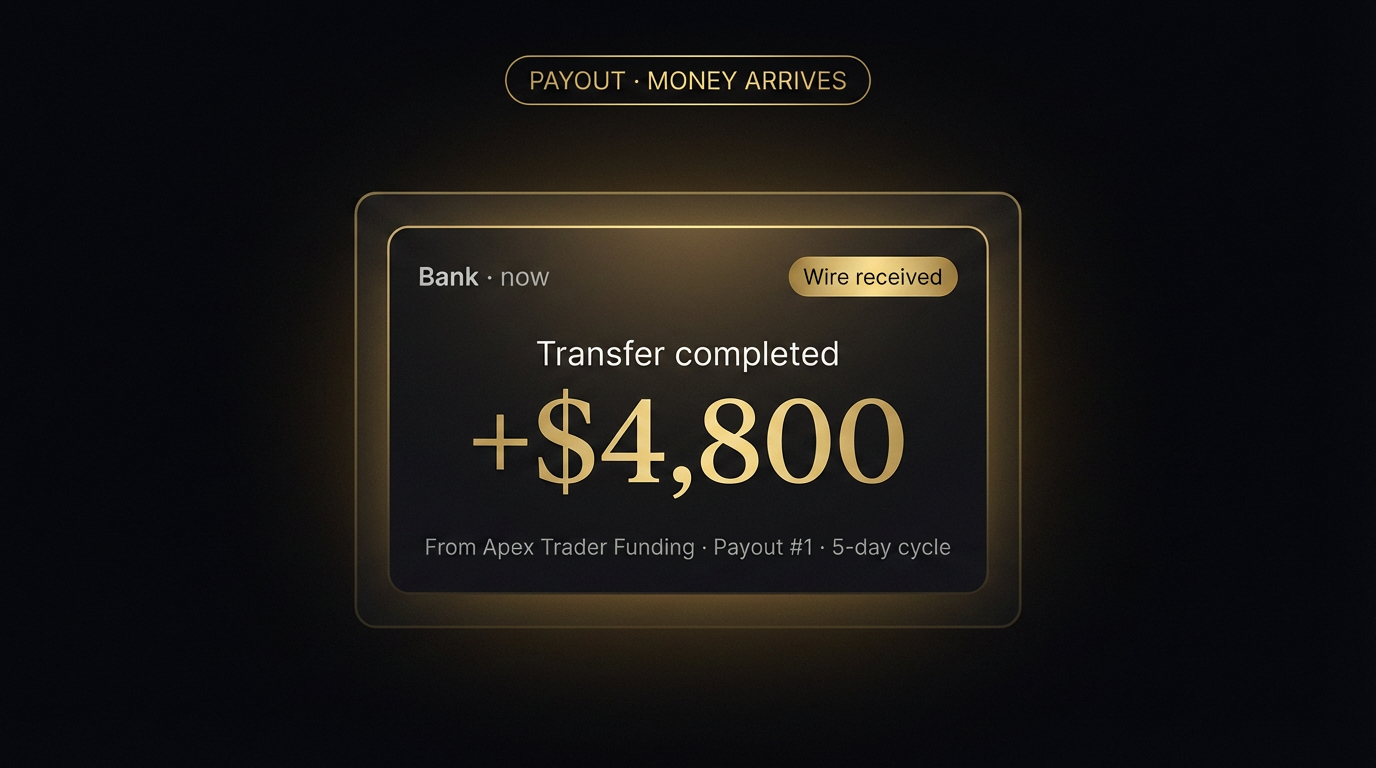
TL;DR, Payout is the moment when a Prop Firm stops being a promise and becomes real income. In 2026, solid firms pay predictably, but the net result in your pocket depends on four variables: Profit Split (80% to 100%), frequency (weekly to monthly), withdrawal method (Bank Wire, USDC, Wise, Prepaid Card), and rules that can block the request (Consistency Rule, min trading days, pending KYC). This guide breaks down each: real timeframe for the first withdrawal per firm, comparative matrix of the 6 main ones, withdrawal methods with real fees, taxation in Brazil, multi-account strategy, red flags for firms that don't pay, and the exact moment to scale instead of withdraw. By the end, you will have a payout plan applicable to your next cycle.
| Payout numbers (2026) | |
|---|---|
| Average market Profit Split | 80% to 90% |
| Average first payout timeframe | 5 to 14 calendar days |
| Average subsequent payouts timeframe | 48 to 72 hours |
| Fastest method in 2026 | USDC via TRC-20 (24 to 48h) |
| Most expensive method | International Bank Wire (4% to 7%) |
| % of payout requests approved without review | About 85% in solid firms |
| #1 cause of blocked payout | Incomplete KYC or Consistency Rule |
| Allowed frequency in most firms | Weekly to monthly |
The truth about payouts: Solid Prop Firms pay, but the devil is in the rules
The first thing a trader needs to understand in 2026 is that the Prop Firm ecosystem has matured. Firms like FTMO, Apex, Bulenox, FundingPips, and The5%ers pay out tens to hundreds of millions of dollars annually, with auditable public history on forums like Prop Reviews, MyFxBook, and Trustpilot. The question "does the firm pay?" has practically ceased to be the critical point among established firms, what varies is how it pays, how much it pays, and when it pays.
The problem, therefore, is no longer "will I get paid?". It's "how much of my performance will be left after the Profit Split, fees, exchange rates, and taxes?". And that's where the devil is in the details: a firm with a 100% Profit Split that allows 1 payout per month, with a US$ 40 Bank Wire fee, pays less at the end of the quarter than a firm with 80% and 4 payouts per month in USDC with US$ 1 gas fee. The difference is mathematical, not emotional.
The second truth is less comfortable: about 15% of payout requests undergo some manual review before being released, strict Consistency Rule, suspicion of copy trading, pending KYC document, divergent bank details. In solid firms, this review ends with the payout approved within an extra 48 to 96 hours. In unknown firms, it can turn into a silent denial. Choosing the right firm is half the payout strategy.
This guide assumes the reader has already passed the challenge and has a funded account (if not, start with How to Pass the Challenge) and wants to convert performance into money deposited in their account.
The first payout: real timeframe per firm
The first payout is almost always the slowest. This happens because, in addition to normal processing, the firm performs full KYC verification (identity document, proof of residence, verification selfie), validates payment details (name on bank account matches name in registration, crypto wallet confirmed), and, in many cases, conducts a manual review of the trading history to ensure rules have been respected.
The good news: once this initial cycle is completed, subsequent payouts clear in a fraction of the time. An Apex that took 5 days for the first request usually delivers the second in 48 hours. An FTMO that took 14 days for the first cuts the second to 7 days.
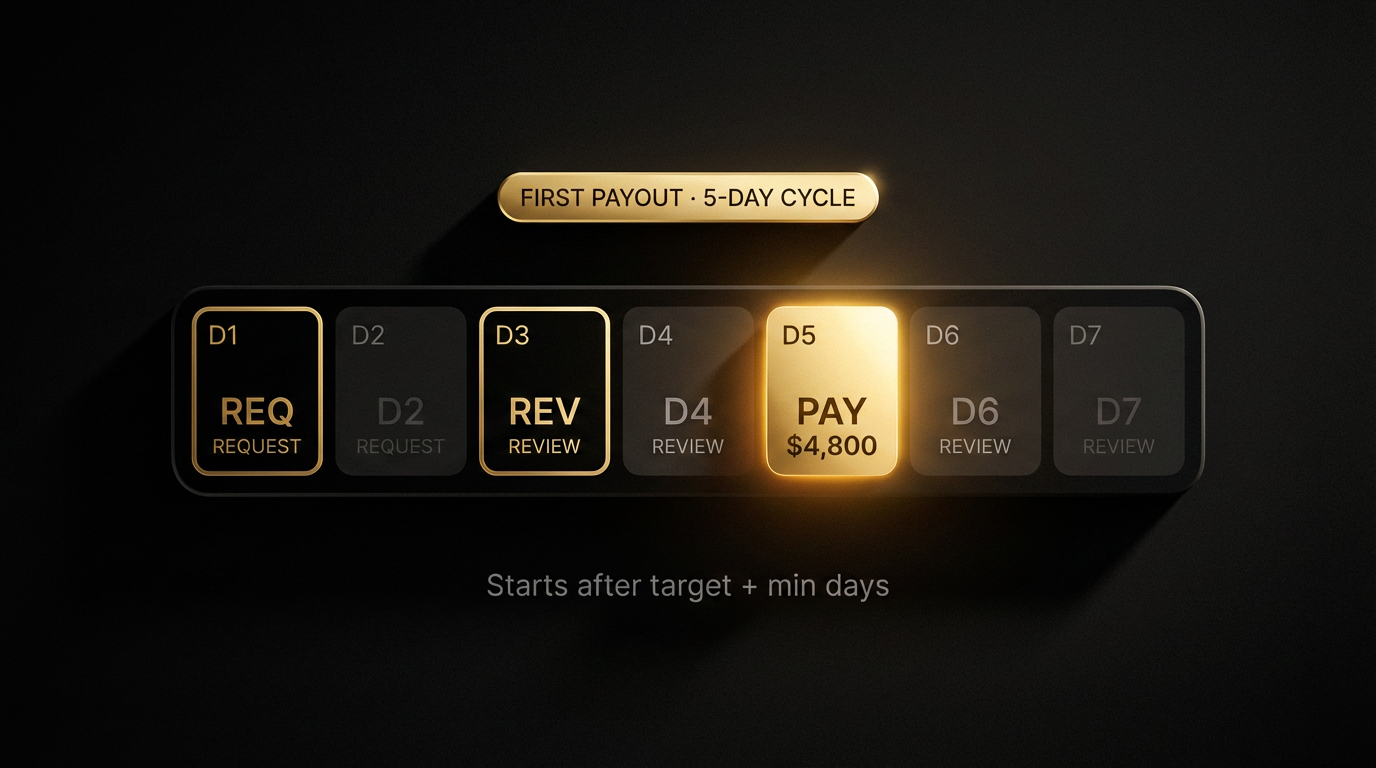
Standard first payout timeline: Day 0, request. Day 1 to 3, KYC and document review. Day 2 to 5, operations validation (Consistency Rule, min trading days, prohibited rules). Day 5 to 7, approval. Day 7 to 14, method processing (Bank Wire slower, USDC faster). Typical total: 5 to 14 calendar days in most solid firms in 2026.
Average timeframes per firm (first payout, 2026)
- Apex: around 5 business days after eligibility, one of the fastest in the Futures market.
- Bulenox: approximately 5 days, similar timeframe to Apex, comparable profile.
- FTMO: up to 14 calendar days, minimum 30-day trading cycle in the funded phase + processing, it's the most conservative.
- FundingPips: between 5 and 14 days depending on the plan, faster on premium plans.
- The5%ers: up to 14 days, full initial cycle, subsequent ones in 7 days.
- E8: between 5 and 10 business days, 1-step model, direct processing.
These timeframes are averages verified in public reports from trading communities in April 2026. They may vary due to the firm's queue, bank holidays, and the complexity of the individual trader's KYC.
Anatomy of a payout: the 4 steps from request to release
Understanding each step of the process is what allows the trader to avoid blocks in the request. The standard flow in solid firms in 2026 has four steps.
Step 1: eligibility
Before being able to request a payout, the trader must be eligible. Typical criteria include: meeting the minimum number of trading days required by the firm (from 5 to 30 days, depending on the plan), not having violated any rules (Drawdown, Daily Loss, Consistency), having accumulated profit above the minimum withdrawal amount (generally US$ 100 to US$ 500), and having approved KYC. If any are not met, the request is not even opened.
Step 2: request and queue
With eligibility confirmed, the trader opens the request in the firm's dashboard, choosing the amount and method. The request enters an internal processing queue. In large firms (FTMO, Apex), this queue can have thousands of requests per day, and the order is first-come, first-served, with the exception of requests that fall into manual review.
Step 3: processing and review
The firm validates the request: checks rules met, confirms updated KYC, verifies that payment details match the registration. About 85% of requests pass directly. The remaining 15% fall into manual review, generally due to suspicion of copy trading, data inconsistency, or Consistency Rule at the limit. Review in solid firms happens within an extra 48 to 96 hours.
Step 4: release and confirmation
Once approved, the payout is sent by the chosen method. Bank Wire takes 3 to 7 business days to appear in the trader's account (depends on intermediary banks). USDC takes 24 to 48 hours (depends on the network and gas). Wise in 1 to 3 business days. Prepaid Card, usually on the same day. The firm sends an email notification confirming the release, from here, tracking is with the method, no longer with the firm.
Those who understand these four steps are rarely caught off guard by a "delayed" payout. Almost always, the request is in a specific stage that has its own timeframe.
Comparative Matrix: Split, frequency, and first payout per firm
The table below consolidates the 6 most relevant firms in the market in April 2026 across the variables that truly matter for calculating the real payout.
| Firm | Initial Profit Split | Maximum Profit Split | Payout frequency | First payout |
|---|---|---|---|---|
| Apex | 100% up to US$ 25k | 90% after US$ 25k | Every 5 business days | ~5 business days |
| Bulenox | 90% | 100% | Weekly | ~5 days |
| FTMO | 80% | 90% | Every 14 to 30 days | Up to 14 days |
| FundingPips | 80% to 90% | 100% (Pro plan) | Weekly | 5 to 14 days |
| The5%ers | 80% | 100% (High Stakes) | Bi-weekly | Up to 14 days |
| E8 | 80% | 90% | Bi-weekly | 5 to 10 business days |
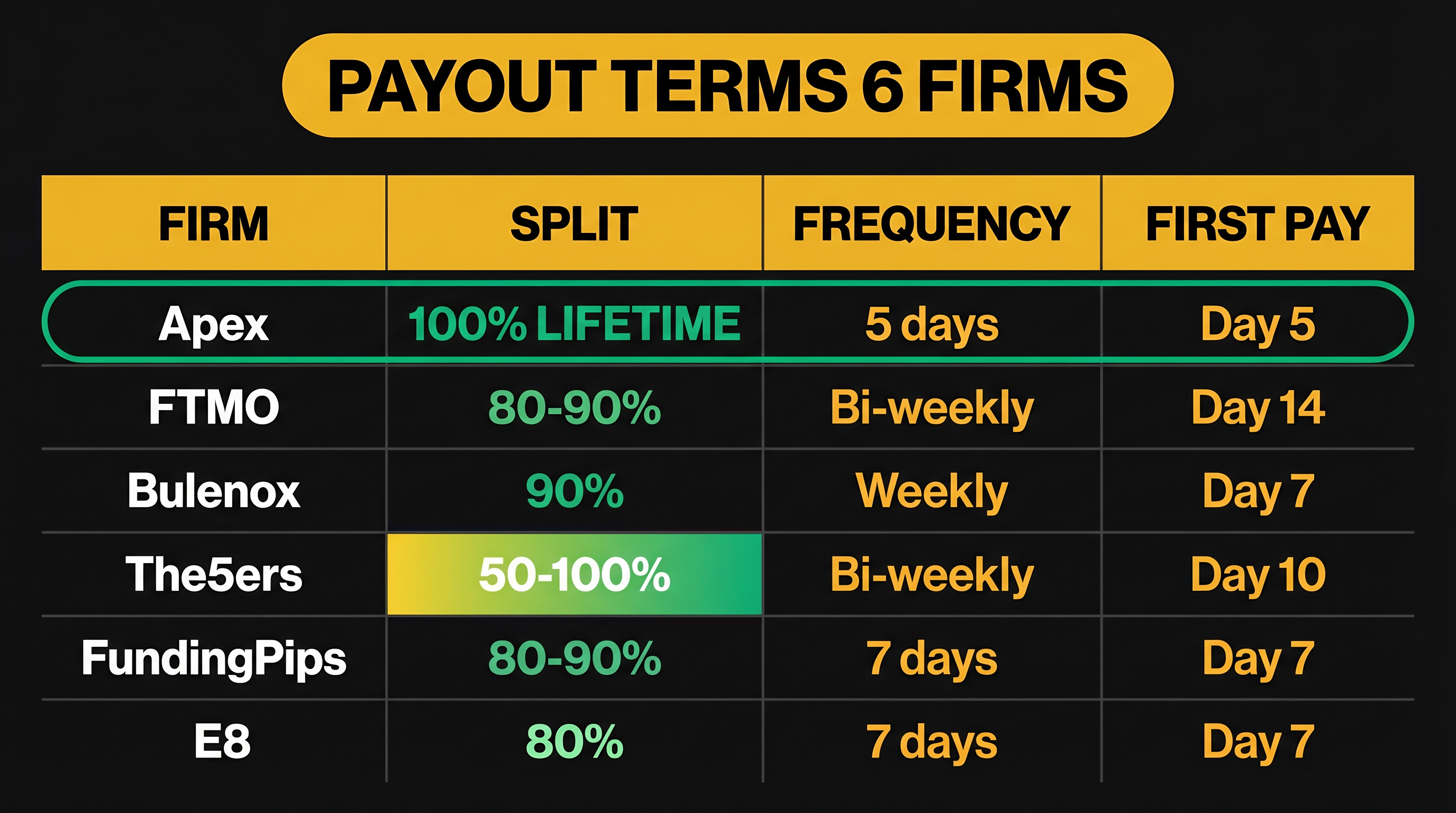
A common mistake is choosing a firm based on the highest nominal split. A trader who makes US$ 2,000 net profit in a month has a better outcome with Bulenox at 90% and 4 weekly withdrawals (US$ 1,800 received in 4 installments) than with FTMO at 80% and 1 monthly withdrawal (US$ 1,600 in a single installment, 30 days later). Split alone is an incomplete metric. Split × frequency × absence of blocks is the real payout formula in 2026.
Withdrawal Methods: Bank Wire, USDC, Wise, Prepaid Card
The withdrawal method can eat up 0.3% to 7% of your payout depending on the combination of fees, exchange rates, and IOF. For those who receive regularly, choosing the right method means thousands of dollars more per year.
Bank Wire (international bank transfer)
The traditional method. The firm sends the amount in USD (or EUR, depending on the headquarters) to the trader's bank account, passing through intermediary (correspondent) banks. In Brazil, the receiving bank automatically converts to BRL at the commercial exchange rate of the day.
Fees: US$ 25 to US$ 45 from the issuing bank + US$ 15 to US$ 40 from the receiving bank + 1.1% IOF + exchange spread of 2% to 4%.
Time: 3 to 7 business days.
When to use: large payouts (above US$ 5,000) where the fixed fee is proportionally small.
USDC (stablecoin on crypto network)
The method that grew most in 2026. The firm sends USDC (1:1 stable digital dollar) to the trader's crypto wallet, which then converts to BRL on a Brazilian exchange (Mercado Bitcoin, Binance, Foxbit).
Fees: US$ 1 (TRC-20) to US$ 25 (ERC-20) gas + 0 to US$ 25 processing fee from the firm + selling fee on the Brazilian exchange (0.2% to 1%).
Time: 24 to 48 hours (sending) + 1 day for selling on the exchange.
When to use: almost always above US$ 200. The most efficient method in 2026.
Wise (formerly TransferWise)
International payment provider with much lower fees than traditional Bank Wire. The firm sends USD to the trader's Wise account, which converts internally and transfers to the BRL account in Brazil.
Fees: 0.5% to 1% Wise fee + very low exchange spread (near mid-market) + 1.1% IOF on withdrawal to Brazil.
Time: 1 to 3 business days.
When to use: when the firm offers Wise as an official option (not all do). Great middle ground between speed and cost.
Prepaid Card (international prepaid card)
The firm credits the payout to a virtual or physical card (Mastercard, Visa) in the trader's name. The balance can be used directly for purchases or withdrawn from an ATM. Less common in 2026 for Brazilian traders due to the 5.38% IOF on foreign currency withdrawals.
Fees: 0 to US$ 10 issuance + 1.5% to 3% card fee + 5.38% IOF on withdrawal + ATM spread.
Time: same day as credit.
When to use: rarely for Brazilian traders, only worthwhile for those who travel frequently and spend in foreign currency.
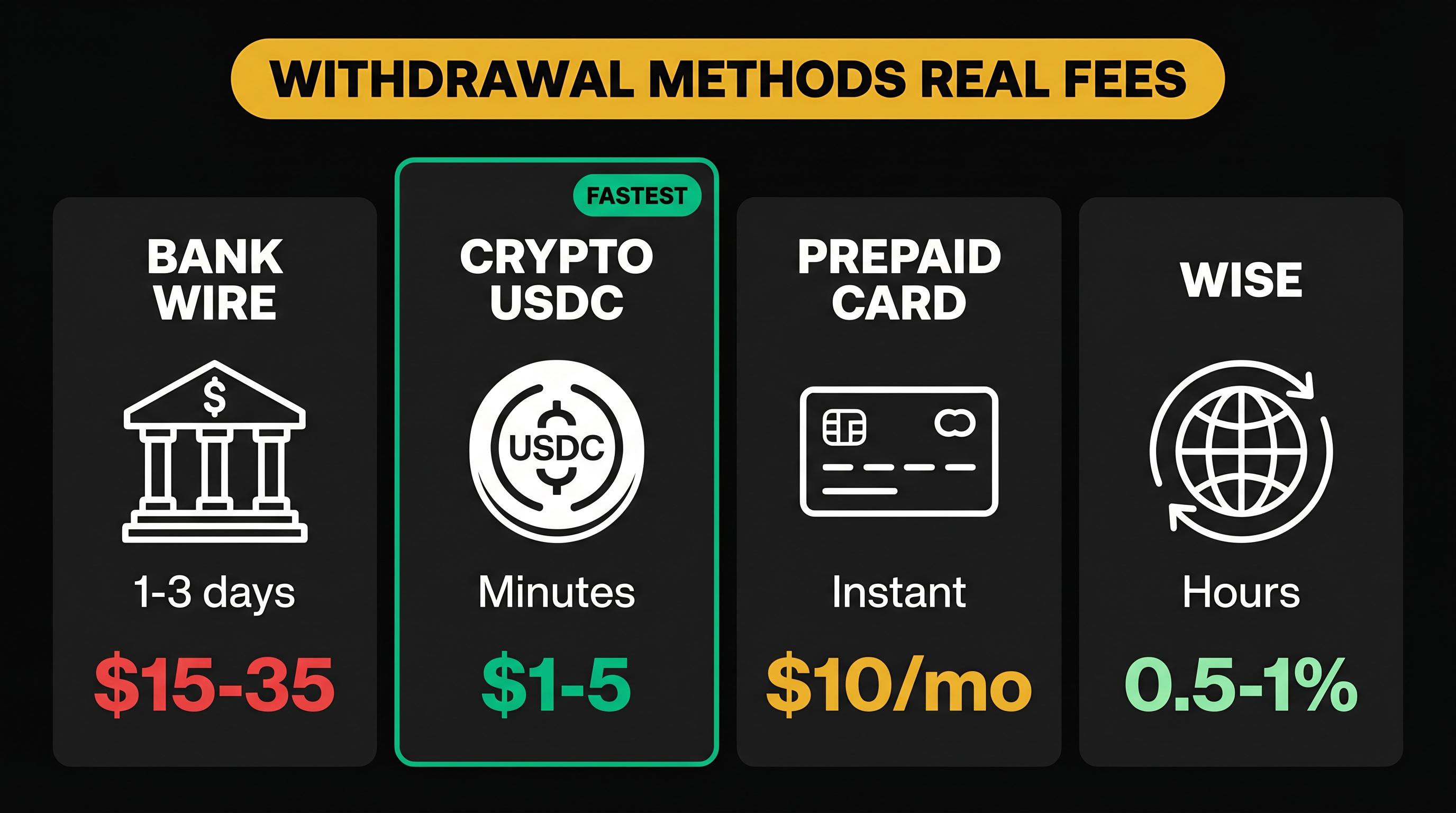
Golden rule 2026: for payouts up to US$ 500, always use USDC via TRC-20 (fee less than US$ 2). For payouts between US$ 500 and US$ 5,000, USDC or Wise. For payouts above US$ 5,000, Bank Wire starts to be competitive due to the diluted fixed fee. Never use a Prepaid Card for residents in Brazil except in very specific cases.
Progressive Profit Split: how to go from 80% to 100%
One of the most underutilized mechanics in the market is the progressive Profit Split: the trader starts at an initial split (typically 80% or 90%) and, as they reach payout or volume milestones, the split increases, in some firms up to 100%. Understanding this curve is what differentiates the trader who maximizes income from the one who leaves money on the table.
Apex: progressive split with initial cap
Apex practices a specific model: the first payout has a 100% Profit Split up to the first US$ 25,000 accumulated per account. After this milestone, the split changes to 90% for the remainder. The practical implication is that a trader who reaches US$ 20,000 in accumulated profit is still at 100%, they should withdraw the maximum allowed before crossing the US$ 25,000 threshold to maximize the split in the 100% range.
FTMO: progressive split for sustained performance
FTMO practices a standard 80% and increases to 90% via the firm's loyalty program, the trader moves up when maintaining positive performance for consecutive periods. The important detail is that the higher split is per account, not per trader: changing accounts resets progress.
FundingPips and Bulenox: split by plan
Instead of a temporal progressive split, these firms offer plans with different splits from the outset. Premium plans (more expensive) start at 90% or 100%. The decision is made at the time of purchase, not over time.
The5%ers High Stakes: 100% via specific model
The5%ers High Stakes line uses a 100% split with more aggressive targets and Drawdown. It's a self-selecting model: it's only worthwhile for those with consistent statistics, because the greater reward comes with proportionally greater risk.
The conclusion: Profit Split is variable, not constant. Planning the account trajectory within each firm, when to scale size, when to migrate plans, when to withdraw before crossing a threshold, is what transforms a good trading strategy into a good payout strategy.
The rhythm of income: from initial KYC to recurring payout
Experienced funded traders converge on a three-phase payout pattern over the first year with a firm. Understanding this rhythm helps calibrate expectations for speed and volume.
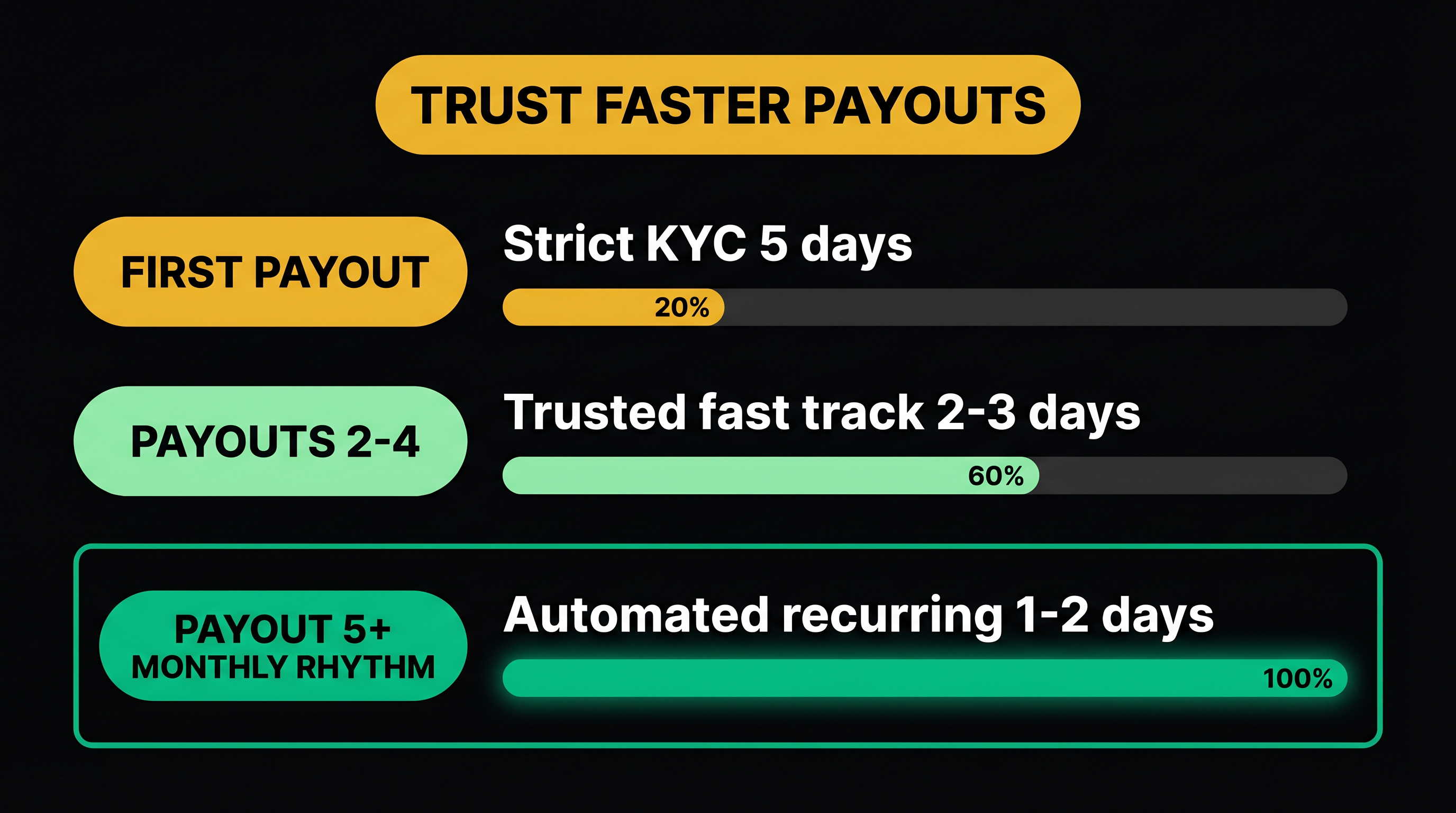
Phase 1, Initial KYC (payouts 1 to 3)
In the first 2 to 3 payouts, the firm is learning about the trader: documentation, trading pattern, account stability. Manual reviews are more frequent, timeframes are longer (7 to 14 days), withdrawn amounts tend to be more conservative. This is the "earning system trust" phase.
Phase 2, Fast track (payouts 4 to 10)
After the initial history is validated, the firm's system recognizes the trader as low operational risk. Payouts drop to 48 to 72 hours, manual reviews practically cease, larger amounts are approved without question. This is when the payout becomes "predictable."
Phase 3, Automated recurrence (payouts 10+)
From the tenth payout onwards, the trader is in the "VIP client" pattern of the system. Some firms offer automatic payments on a fixed date of the month, higher split for loyalty, access to larger plans without a new challenge. This is when the Prop Firm stops being a sporadic activity and becomes a structured cash flow.
The implication: the first 3 months with a firm are an investment in relationship, not just performance. Respecting all rules, submitting complete documents, not creating unnecessary friction, all this accelerates the arrival of Phase 3, where real payout happens at scale.
Rules that block payouts: Consistency Rule, min trading days, and violations
Denied or blocked payouts are rarely arbitrary in solid firms. Almost always, it's a consequence of a specific rule not being met. The three most common are:
Consistency Rule
The firm requires that no single day accounts for more than X% of the total profit for the period (typically 30% to 40%). A trader who makes US$ 1,000 in one day and US$ 500 in the other 10 days may violate Consistency and have the payout blocked until the next period balances out. The rule exists for the firm to protect itself from results based on "one-day luck."
Minimum trading days
Most firms require at least 5 to 30 days of active trading in the period before allowing withdrawal. A trader who profits on day 1 and tries to withdraw on day 3 is not eligible. It's an anti-luck protocol: the firm wants to see behavior over time, not an isolated peak.
Operational violations
Operating during prohibited hours (typically during high-impact news releases in firms that prohibit news trading), using forbidden strategies (latency arbitrage, copy trading between accounts, hedging between firms), or leaving a position open overnight when not allowed. Each of these can not only block the payout but also close the account.
Golden rule before each payout: complete the checklist of the 4 pillars: clean Drawdown, Consistency within range, minimum days met, updated KYC. If any point is in doubt, resolve it before opening the request. A payout opened with pending issues automatically falls into manual review and is delayed by 3 to 5 days.
Taxation in Brazil: how to declare Prop Firm payouts
This is perhaps the most under-documented topic in the market and, at the same time, the most consequential in the medium term. In 2026, the prevailing understanding of the Brazilian Federal Revenue classifies Prop Firm payouts as income received from a foreign source, subject to monthly taxation via Carnê-Leão, with a progressive rate according to the IR table, from 7.5% to 27.5% depending on the monthly amount.
In practice, this means the trader must:
- In the month the payout is received, calculate the amount in BRL at the exchange rate of the day of receipt.
- Access the Carnê-Leão system on the Federal Revenue's e-CAC portal and declare the income.
- Pay the corresponding DARF by the last business day of the following month.
- In the Annual Declaration, report the annual total as "Income Received from Foreign Sources."
Alternatively, some traders structure via a legal entity (Simples Nacional, Lucro Presumido), where taxation can fall to lower brackets depending on the regime. The viability of this structure depends on monthly volume and the characteristics of the contract with the firm.
An important observation: the relationship between the trader and the Prop Firm is usually contractor-client, not employee-employer. The trader is not an employee of the firm, they are a service provider or contractor. This has different tax implications than a CLT job.
This guide is strictly educational. Consult an accountant specialized in trading before any declaration. Incorrect tax classification in the first year can generate a notification from the Federal Revenue in subsequent years, and regularizing it later costs much more than paying correctly the first time.
Multiple accounts, multiple payouts: diversification strategy
Experienced funded traders in 2026 rarely operate a single account. The reason is mathematical: the Profit Split is applied per account, challenge fees are often on promotion with heavy discounts (70% to 90% off at firms like Apex, Bulenox), and operational risk is diluted when spread across 2 to 4 accounts in parallel.
Benefit 1: payout scaling
Three Apex 50K accounts with US$ 1,500 profit each generate three independent payouts (US$ 4,500 total) instead of a single US$ 4,500 payout on an Apex 150K. The difference is that the Drawdown and Daily Loss of each individual account is smaller, but the trader has more operational flexibility in each one.
Benefit 2: reduced concentrated risk
If one account blows up (and it does, it's part of the game), the others continue. A single mistake doesn't erase the entire operation. Resetting one account costs US$ 80 to US$ 150 (Apex), much less than an entire new challenge.
Benefit 3: payouts in different windows
By staggering trading days and eligibility, the trader can have payouts arriving almost every week of the month (week 1 account A, week 2 account B, week 3 account C). Cash flow becomes continuous instead of one-off.
Caution: copy trading is prohibited
Operating exactly the same strategy at the same time across all accounts violates most firms' policy. The legitimate way is to have an independent plan per account: different times, different assets, different sizes. See the Drawdown guide for details on managing multiple accounts.
The biggest risk: a firm that vanishes before paying, red flags 2026
The worst possible scenario in a Prop Firm is not blowing the Drawdown. It's the firm disappearing with the payout after you've already generated the profit. In 2026, with a more mature market, this type of event has become rarer among established firms, but new, small firms with aggressive marketing remain a real risk. The signs to watch:
Red flag 1: above-average split, below-average challenge fee
A firm offering a 100% Profit Split with a US$ 19 challenge on a 100K account is burning money. Either it's an aggressive promotion (temporary, justified) or it's a pyramid: the firm lives on challenge fee money, not on the trader's real performance. When the flow of new traders stops, the payouts stop too.
Red flag 2: absence of public payout history
Solid firms have dozens to hundreds of posts on forums like Prop Reviews, MyFxBook, Trustpilot, Reddit r/Daytrading, with traders posting real payout proofs over 1, 2, 3 years. A firm without this history, no matter how beautiful the website, is a blind bet.
Red flag 3: slow or robotic support
Test before contracting: open a support ticket asking something specific. Response time, quality of the answer, whether it's human or bot, whether they respond in your language, all of this predicts how it will be at payout time with a problem.
Red flag 4: abusive or ambiguous terms of service
Read the terms before passing the challenge. Solid firms have a clear contract about when they pay, when they deny, what constitutes a violation. Dubious firms have sweeping clauses like "the company reserves the right to refuse any payment at its sole discretion", translation: they don't pay and owe you no explanation.
Red flag 5: payment only in crypto with no bank option
It's not crypto itself that's the problem (on the contrary, it's fast and cheap). The problem is only crypto, firms that refuse to pay by Bank Wire or Wise are fleeing the formal banking system, where there would be an auditable record if they vanished.
Warning: if 2 or more of the red flags above are present, don't contract. No 100% split compensates for a firm that doesn't pay. In 2026, the list of trustworthy firms is reasonable: Apex, Bulenox, FTMO, FundingPips, The5%ers, E8, City Traders Imperium, BrightFunded, FundedNext. Outside these, research twice as much before risking it.
Scale or withdraw: the decision that defines long-term results
Every funded trader reaches a specific moment where the question arises: "I received US$ 2,000 in profit, do I withdraw it all or let it capitalize?". The right answer depends on three variables worth mapping before the moment.
Variable 1: the split after the cap
In firms like Apex, the 100% split has a cap (US$ 25,000 per account). Above that, the split drops to 90%. Withdrawing everything before crossing the line maximizes the effective split. Letting it capitalize only makes sense if the firm keeps the split constant above the cap.
Variable 2: the post-payout Drawdown
In an Apex account, withdrawing the profit lowers the balance back (approximately) to the pre-profit level, which can reactivate the active Trailing Drawdown. Understanding whether the account is pre- or post-drawdown floor (see the Drawdown guide) decides whether the withdrawal is safe or risky.
Variable 3: opportunity from other accounts
If the trader has 3 active accounts, withdrawing from one and using part of the profit to buy a fourth (at the firm's discount) can multiply the next cycle. It's capital allocation for capacity, not for consumption.
Consensus rule
Most long-lasting funded traders practice: withdraw approximately 70% of the profit, reinvest 30% in expansion (new accounts or larger plans), keep the account balance always near post-floor. This proportion balances real income with operational growth. Extremes (withdrawing 100% or reinvesting 100%) rarely optimize a 12-month result.
Frequently Asked Questions
Do I need to wait a minimum period to request the first payout?
Yes, in virtually all firms. Apex requires eligibility (minimum 5 positive trading days). FTMO requires 30 days of activity in the funded phase before the first request. FundingPips and Bulenox have smaller windows (5 to 10 days). Always confirm the specific minimum of your plan in the firm's dashboard before counting timeframes.
Can I change the payment method after the first payout?
Yes, with most firms. The method is chosen with each request, not contracted permanently. A trader can take the first via Bank Wire and the second via USDC without a problem, as long as they keep the payment details updated in the dashboard.
If I violate Drawdown after requesting a payout, is the payment canceled?
It depends on the timing. If the violation happens before the request is approved, most firms cancel the payout and close the account. If it happens after approval but before final processing, in solid firms the approved amount is paid normally and the account is closed afterward. Always avoid trading in the window between request and confirmation.
What is the minimum payout amount?
It varies: Apex approximately US$ 500 on the first, US$ 2,000 on subsequent ones (on some plans). FTMO US$ 100 minimum. FundingPips US$ 50 on small plans. Bulenox US$ 100. Check the dashboard for the specific amount of your plan.
Do I pay a fee for the firm to withdraw?
In solid firms, the firm's own processing fee is zero or symbolic (US$ 0 to US$ 25). What weighs are the fees of the withdrawal method (Bank Wire, crypto network gas, Wise, etc.), not the firm's. Be suspicious of a firm that charges a high fee for its own payout operation, it's a sign of a tight financial model.
Can I withdraw in a currency other than USD?
Few firms offer this natively. Most pay in USD (or USDC) and leave the conversion to the trader via bank, exchange, or Wise. Some European firms (The5%ers, on some plans) allow payout directly in EUR.
Does the payout count as my company's revenue or personal income?
It depends on how you registered with the firm. If registered as an individual, the payout is your personal income. If registered via a legal entity (when the firm allows), it enters as company revenue. Most firms allow both models, a choice that impacts taxation. Consult a specialized accountant before deciding.
What is the next thing I should read?
If you haven't passed the challenge yet, start with How to Pass the Challenge. If you've already passed and want to protect the funded account, read Drawdown Management. If you want to refine position size to optimize profit (and therefore payout), go to Position Sizing in Prop Firms. For the general market overview, What is a Prop Firm.
Conclusion: the payout is the goal, not chance
Many people enter a Prop Firm thinking about the challenge. Then they think about the Drawdown. Then they think about Consistency. The payout always appears last in the mental queue, and it's exactly this ordering that makes technically competent traders withdraw much less than they could.
The payout is the goal of the entire operation. Every prior decision, which firm to contract, which plan to choose, which payment method to register, when to request the withdrawal, how to size multiple accounts, how to declare in Brazil, should be made as a function of the real payout at the end of the cycle, not the nominal performance on the chart.
Traders who treat payout as strategy, not as consequence, converge on three habits: they choose firms by public history, not by marketing; they calculate the net payout (split × frequency × method × taxes) before contracting; they treat the first 3 months as an investment in the relationship with the firm's system. After that, the payout becomes recurring and the funded account stops being a bet and becomes cash flow.
If this guide leaves a single message, let it be this: money only exists when it's in your account. Profit on the chart is a number; a confirmed payout is income. Prioritize the second in every decision.
Ready to choose the right firm for your next payout cycle? Compare all firms with filters for Profit Split, frequency, and history at marketscoupons.com and apply a coupon to start with the lowest possible entry cost.
Related Guides
- What is a Prop Firm, Model, history, and the role of allocated capital in 2026
- How to Pass the Challenge, The 4 pillars, routine, and approval method
- Drawdown Management, 3 types of Drawdown, drawdown floor, and personal circuit breaker
- Position Sizing in Prop Firms, Mathematical formula to size each trade
Disclaimer: This guide is educational content. Markets Coupons does not provide financial advice, does not issue investment recommendations, and does not guarantee results in Prop Firms. Trading involves risk. Payout rules, Profit Split, taxation, and commercial conditions of firms change periodically, always confirm the current conditions directly through the firm's official channels before making a decision. For tax matters, consult a specialized accountant.