Drawdown Management in Prop Firms: The Definitive Guide to Survival in 2026
Last updated: April 20, 2026, 18 min read
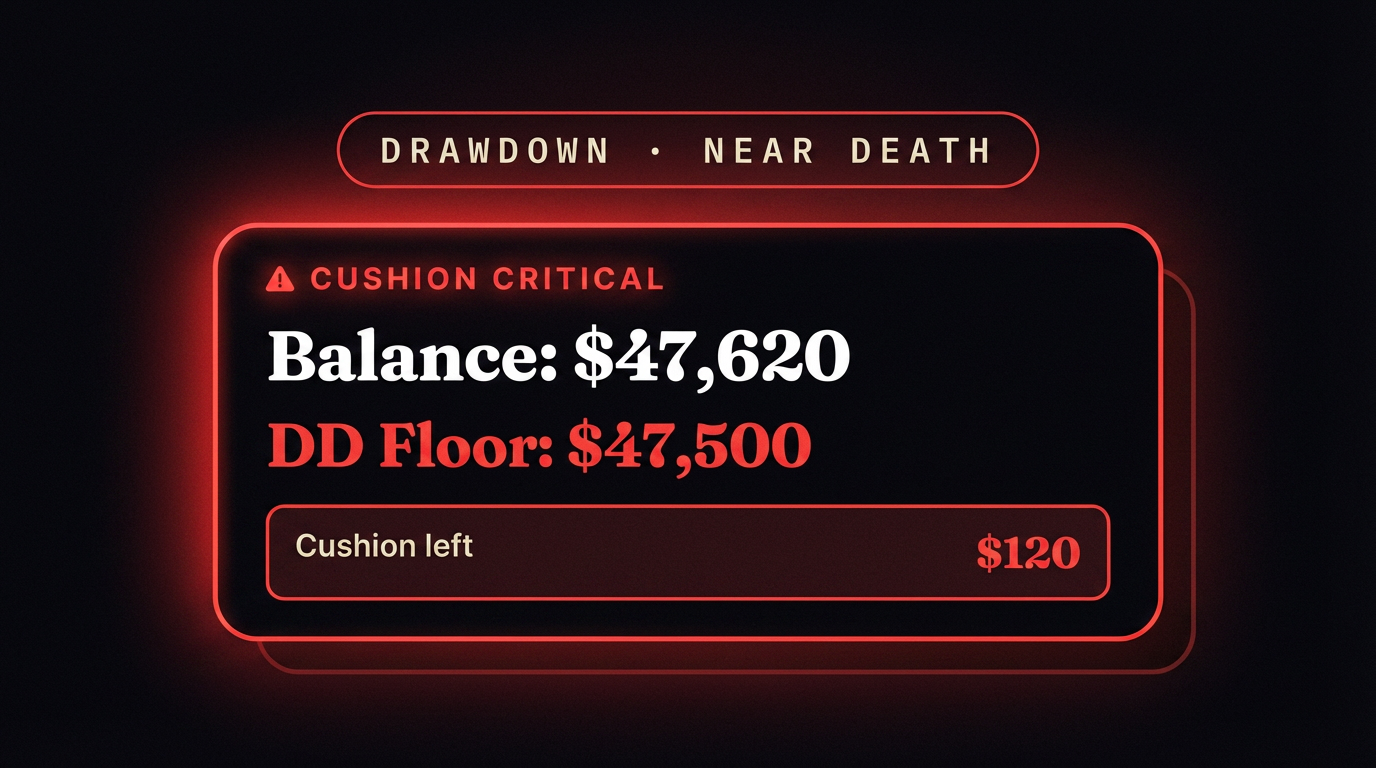
TL;DR, Drawdown is what separates those who last months in a funded account from those who burn through their challenge fee in 3 days. It's not a technical detail: it's the main metric every Prop Firm uses to decide if you stay or go. This guide explains the exact mechanics of the 3 types (static, trailing EOD, and trailing intraday), the concept of drawdown floor that saves Apex accounts, compares the rules of Apex, FTMO, Bulenox, FundingPips, The5%ers, and E8, shows the cruel math of recovery (why -50% requires +100% to get back), teaches the safety margin formula before each trade, and defines the personal circuit breaker. By the end, you will have a concrete protocol to protect your account in any firm, in any market.
| Drawdown Numbers (2026) | |
|---|---|
| % of failures caused by Drawdown | Around 80% |
| Most common type in Futures | Trailing End-of-Day |
| Most common type in Forex | Static / fixed |
| Recommended safety margin | 50% of Daily Loss as personal ceiling |
| Gain needed to recover -20% | +25% |
| Gain needed to recover -50% | +100% |
| Average recovery time from a bad day | 3 to 5 days trading with discipline |
| Day of the week with most violations | Friday (rush to close the week) |
What is Drawdown and why it kills 90% of accounts
Before any technical discussion, a direct definition: Drawdown is the maximum accumulated loss limit that the firm accepts before closing your account. Translating to everyday terms: in an Apex 50K account with a Trailing Drawdown of US$ 2,500, your balance can never be more than US$ 2,500 below that account's historical peak. Touching this limit even once, even for 1 second, even with a price wick, closes everything. No warning, no appeal, no "just one more chance".
Why does it kill 90% of accounts? Because most traders operate thinking about profit ("how much do I need to earn to hit the target") while the firm is measuring exactly the opposite ("how much can this trader lose before becoming a loss for our capital"). These are inverse metrics. While you look at the top of the ladder, Drawdown is looking at the floor, and it's the floor that decides if the ladder still exists.
Aggregated data from communities like Prop Reviews and MyFxBook show that about 80% of failures in 2026 are caused directly or indirectly by Drawdown violation, whether it's the total Max Drawdown or the Daily Loss (which is a short-window Drawdown). The rest is divided among Consistency Rule, news trading, and contractual violations.
The implication is clear: if you want to last, Drawdown needs to be the first thing you calculate before each trade, not the target, not the setup, not the asset. First the floor, then the ceiling.
The 3 types of Drawdown: exact mechanics
Not all Drawdown is equal. There are three main models, each with different mechanics, behavior, and level of cruelty. Understanding which model is active in your account is a prerequisite for any real risk management.
1. Static (fixed)
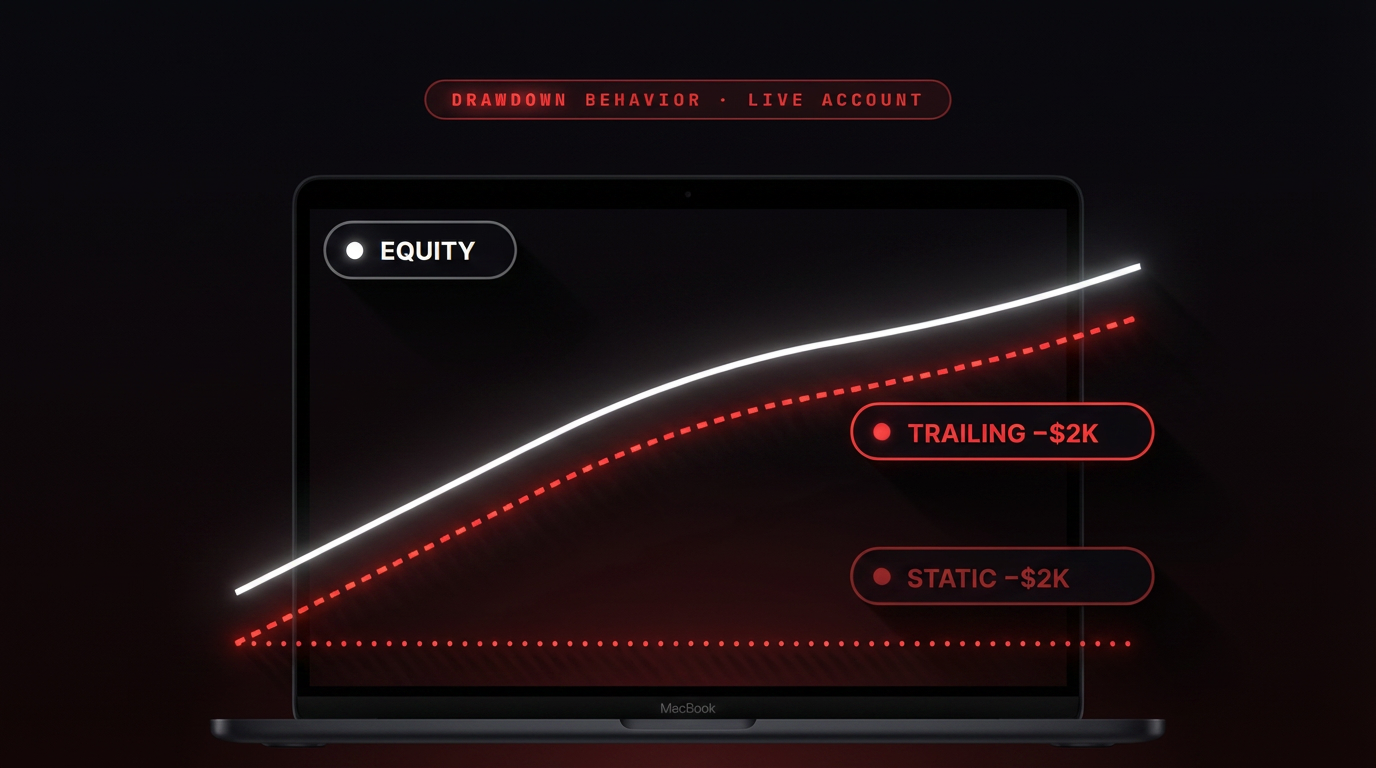
The simplest model: the limit is calculated on the initial balance and does not move. In an FTMO 100K account with a Static Drawdown of 10%, your balance can never fall below US$ 90,000, regardless of whether you reach US$ 110,000 or US$ 95,000. The floor is absolute.
Advantage: predictable. You know from day 1 where the wall is.
Disadvantage: usually comes with a larger target (10% in FTMO's phase 1) because the firm compensates for the risk with a tougher goal.
Where it dominates: Forex (FTMO, The5%ers, part of FundingPips).
2. Trailing End-of-Day (EOD)
The limit moves up with your balance, but only at the end of the day. In an Apex 50K EOD account with a trailing of US$ 2,500, if you end the day with US$ 51,000, from the next trading session your floor becomes US$ 48,500. During the day, the floor remains at US$ 47,500 (previous closing value minus the trailing).
Advantage: you can fluctuate freely during the day without pulling the floor along. An intraday profit that turns into a loss does not push the limit up during the session.
Disadvantage: closing a very positive day and then having a bad streak can quickly activate the wall. The floor moves up at closing and does not go down.
Where it dominates: Apex (EOD option), Bulenox, part of Take Profit Trader.
3. Trailing Intraday
The cruelest model. The floor moves up in real-time, with each new balance peak during the session, including with floating profits (unrealized P&L). In an Apex 50K Intraday account with a trailing of US$ 2,500: you enter a trade, the floating profit reaches +US$ 1,500 (momentary balance US$ 51,500), then returns to zero. Your absolute floor has become US$ 49,000, even if you closed the trade at breakeven.
Advantage: almost none for the trader, it's the firm protecting itself to the maximum.
Disadvantage: brutally punishes those who hold profits and don't realize them. An "almost perfect" trade that reverses at the last second can close your account, even if it ends at zero.
Where it dominates: Apex (Intraday option), Topstep.
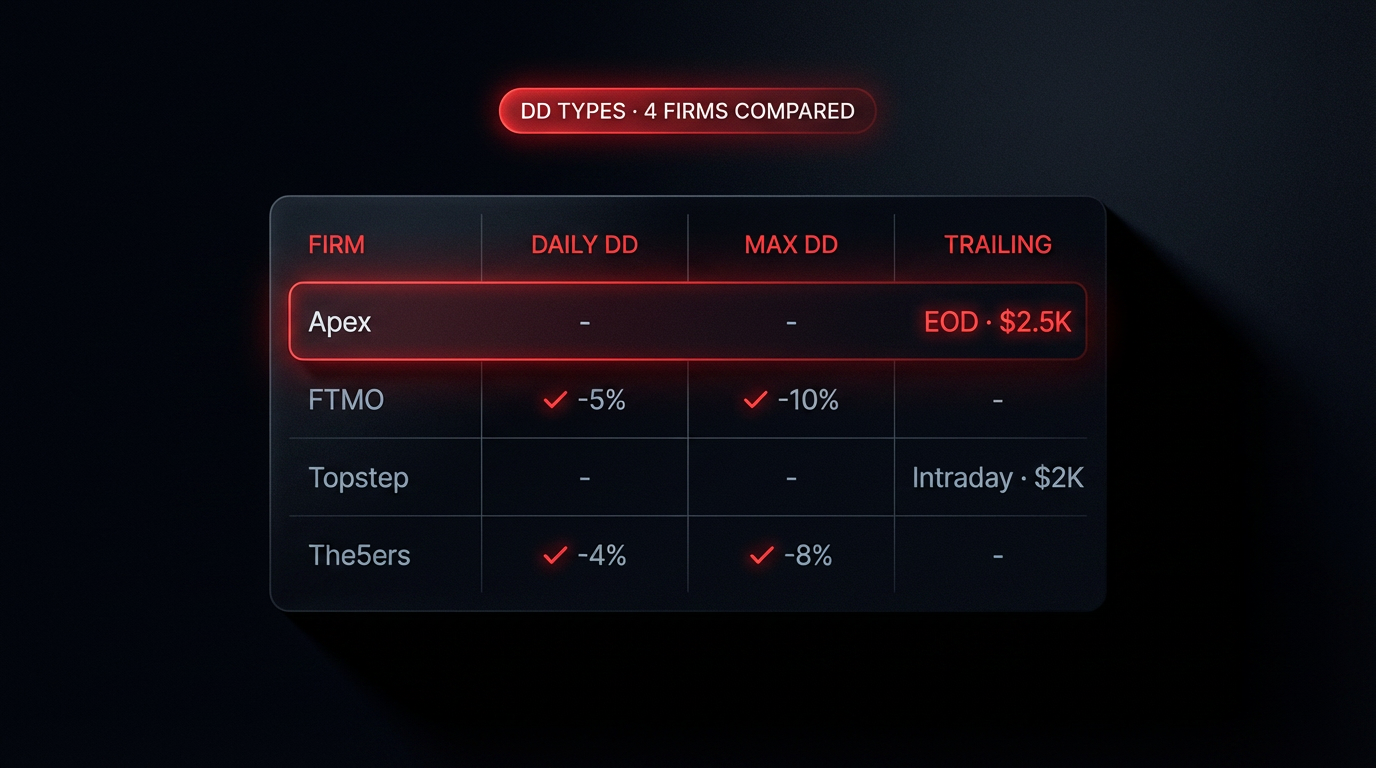
The Daily Loss Limit is a short-window Drawdown
Along with the three main ones, there is the Daily Loss Limit: a 24-hour loss ceiling. In an Apex 50K, it is approximately US$ 1,500. Hitting it on a single day closes the account, even if the total Max Drawdown is still far away. It's a "daily Drawdown", identical in function, with a 1-trading-session window.
The drawdown floor: the concept that saves Apex accounts
Here's a concept that almost no one explains properly and that literally saves thousands of Apex accounts every month: the drawdown floor. It's the point at which the Trailing Drawdown locks and becomes static.
At Apex, the mechanism works like this: in a 50K account with a trailing of US$ 2,500, the floor starts at US$ 47,500 (US$ 50,000 initial minus the trailing). As you gain, the floor moves up. When your balance reaches US$ 52,600 (the initial value + trailing + US$ 100 buffer), the floor permanently locks at US$ 50,000, the initial balance. From that moment on, the Trailing Drawdown no longer moves up, even if your balance reaches US$ 60,000.
The impact of this is enormous. Before the floor, any balance pullback drags you towards the limit in real-time. After the floor, you have an absolute cushion: the balance can fluctuate between US$ 60,000 and US$ 50,000, and the account is protected. This is the moment the account "breathes" for the first time.
The obvious strategy, and one that experienced traders apply, is to trade more aggressively only after activating the floor. Before it, minimum size, maximum discipline. After it, you finally have room to make mistakes without dying.
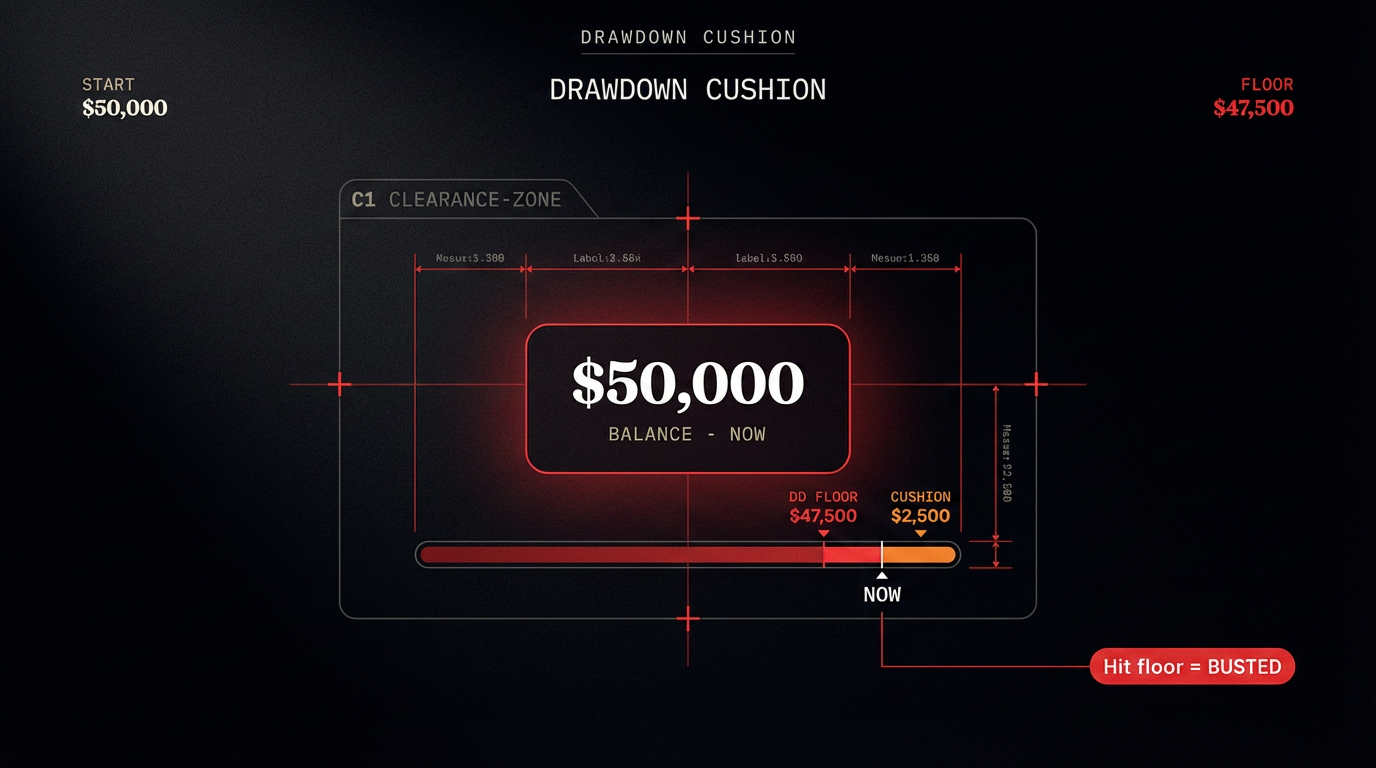
Practical rule: in any Apex account, treat the value "initial balance + trailing + US$ 100" as the most important checkpoint of your cycle. Until reached, you are in survival mode. After reaching it, you are in building mode. Do not confuse the two phases.
Drawdown by firm: the complete comparison 2026
Each firm has its own combination of Drawdown type, limit size, and auxiliary rules. The table below consolidates the rules of the 6 most relevant firms in April 2026.
| Firm | Max DD Type | Value (50K/100K account) | Daily Loss | Observation |
|---|---|---|---|---|
| Apex | Trailing EOD or Intraday | US$ 2,500 (50K) | No formal Daily Loss | Floor locks at initial balance + trailing + US$ 100 |
| Bulenox | Trailing EOD or Static | US$ 2,500 (50K) | US$ 1,100 (50K) | Pro Model with Static is the most flexible |
| FTMO | Static | 10% of initial balance | 5% of initial balance | Absolute floor from day 1 |
| FundingPips | Static or Trailing | 6% to 10% (configurable) | 3% to 5% | One of the most flexible models in the market |
| The5%ers | Static | 4% to 10% | No Daily Loss in some plans | High Stakes uses pure Static |
| E8 | Static | 8% | 4% | 1-step model with 8% target |
What the table hides is more important than what it shows: the type of Drawdown dictates the strategy, not the size. A Trailing of US$ 2,500 in an Apex 50K is more dangerous than a Static of US$ 5,000 in an FTMO 100K, because the first moves against you and the second does not. For beginners, Static models (FTMO, The5%ers, Bulenox Pro, FundingPips Static) are mathematically easier to survive.
The cruel math of recovery
There is a table that every Prop Firm trader should have printed next to their monitor. It shows the percentage gain needed to recover a loss, and the numbers are not intuitive.
| Accumulated Loss | Gain needed to return to the starting point |
|---|---|
| -5% | +5.3% |
| -10% | +11.1% |
| -20% | +25% |
| -30% | +42.9% |
| -40% | +66.7% |
| -50% | +100% |
| -60% | +150% |
| -70% | +233% |
The formula is simple: gain needed = loss ÷ (1 - loss). But the impact is brutal. A 20% loss is not offset by a 20% gain, you need 25% because the base capital is smaller. Losing half the account requires doubling what's left.
Translating to Prop Firm: in an Apex 50K, if you lose US$ 2,000 (40% of your trailing of US$ 2,500), the balance drops to US$ 48,000. To return to the starting point, you need to gain US$ 2,000 trading with the same size. If your routine was 4 trades a day yielding US$ 100 each, that's 20 days trading without error. Twenty days. Without error. The math favors those who don't fall, not those who rise.
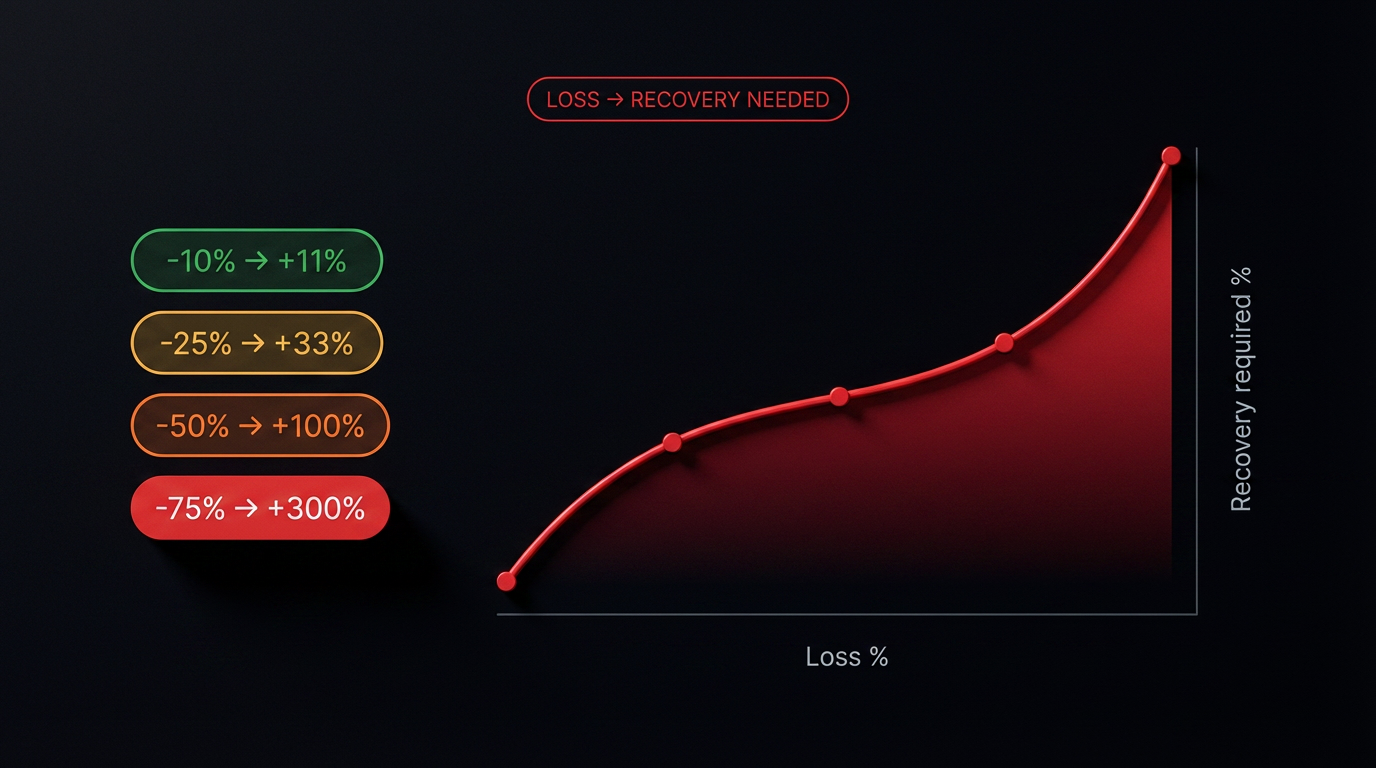
Practical conclusion: the greatest financial asset of a Prop Firm trader is not the signal they discovered, it's the day they didn't trade. Avoiding a 20% drop is worth more than hitting a 20% trade, because the first saves you 25% of recovery effort, the second only compensates the other if the effort has already been made.
How to calculate your safety margin before each trade
The safety margin is the distance between where you are and where the firm closes you, expressed in dollars or percentage. Calculating it before each trade is the most important habit of a funded trader.
Step 1: identify where you are
Current balance. Not yesterday's closing balance, not the balance after the last trade, the balance now, including floating profit or loss. In Trailing Intraday, it includes the momentary peak of the session.
Step 2: identify where the floor is
The absolute value of Max Drawdown and Daily Loss. In an Apex 50K that has already reached a peak of US$ 51,800 today, the intraday floor is US$ 49,300 (US$ 51,800 - US$ 2,500). The Daily Loss floor depends on the day's opening balance.
Step 3: calculate the distance
Safety margin = Current balance - Floor. In the example above: US$ 51,800 - US$ 49,300 = US$ 2,500 margin.
Step 4: apply the divisor of 5
Pragmatic rule: the risk of the next trade cannot be greater than 1/5 of the safety margin. In the example, maximum risk = US$ 500. This divisor exists because you need to withstand at least 5 consecutive losing trades, a statistically common scenario in 20-day cycles, without hitting the floor.
Step 5: always round down
If the calculation yields 1.7 contracts, trade 1. If the calculation yields 3 mini lots, trade 2. Rounding up is what turns a correct thesis into a Drawdown violation over 30 trades.
This 5-step mini-protocol, applied before each trade, eliminates the #1 cause of failure in Prop Firms. The Position Sizing in Prop Firms guide delves into the complete mathematical formula for position size.
The personal circuit breaker: stop rules
The firm's limits (Max Drawdown, Daily Loss) are the absolute wall. Traders who last months in a funded account never get close to this wall, they stop much earlier, at self-imposed personal limits. This is called the personal circuit breaker.
The logic is simple: an electronic market has circuit breakers (automatic stops at 7%, 13%, 20% drops) to prevent panic from feeding itself. The trader needs the same mechanism, because psychologically the temptation to "recover on the next trade" grows exponentially as the loss increases.
Rule 1: daily loss ceiling at 50% of Daily Loss
If the firm's Daily Loss is US$ 1,500, your personal ceiling is US$ 750. Upon reaching it, you close the platform for the rest of the day. This rule protects both the Daily Loss and the Max Drawdown, because it limits the contribution of each bad day to the accumulated drawdown.
Rule 2: stop after 3 consecutive losing trades
Regardless of the amount, 3 losses in sequence = close the platform, even if it's only 10:30 AM. Three consecutive losses mean that the market reading is wrong today, or the emotional state is already compromised. Forcing a fourth trade almost always leads to failure.
Rule 3: stop after hitting daily target
If your daily target is 1% of the balance (US$ 500 in a 50K account) and you hit it, close. It doesn't matter if it's 9:45 AM and the market is "great". Locking in daily profit is what builds the consistent equity curve that the firm requires via the Consistency Rule. The trader who locks in always beats those who "let it run" in the long term.
Rule 4: Friday with reduced target
Friday statistically has the highest concentration of Drawdown violations. Two reasons: (1) pressure to "close the week in positive" increases position size, (2) liquidity drops in the last 2 hours, increasing slippage. Pragmatic rule: on Friday, trade with 50% of normal size and close at noon.
Intraday Drawdown: why it causes more failures than total Drawdown
Of the three types of Drawdown, Trailing Intraday is the one that causes the most traders to fail, and for a specific reason that few people articulate: it punishes unrealized profits. In an Intraday model, the worst possible trade is one that goes to +80% of the target and returns to zero. Psychologically, you "lost nothing". In terms of Drawdown, you just pushed your floor up by 80% of the target, without having captured a single dollar.
This mechanism creates two traps:
Trap 1, the "almost" trade: you enter, profit goes to +US$ 800, you hold expecting +US$ 1,000, it reverses, closes at breakeven. The trade cost nothing in realized P&L, but your floor moved up US$ 800. Repeat 3 times a day and the Max Drawdown became a wall 2 trades away.
Trap 2, the late mental stop: the trade turns against you, you "know" where you want to exit, but at the exit price the spread widened and you lost an additional US$ 200 beyond what was planned. In Trailing Intraday, these extra US$ 200 count against the floor updated by the floating peak, not against the balance at the start of the day.
The countermeasure is behavioral: in an Intraday account, take partial profit at +50% of the target. Half the position exits, the rest manages. This limits the floor's rise to 50% of the movement instead of 100%, exponentially reducing risk in sensitive accounts.
When a bad day turns into an irreversible fall: structural triggers
Not every bad day is terminal. Some are market calibration, others are temporary excess volatility. But there are structural triggers that indicate when a bad day is turning into an irreversible fall. Recognizing these triggers is the difference between losing 1% and losing the account.
Trigger 1: third entry attempt on the same setup
You saw a setup, entered, stop. Entered again, stop. Entered a third time. If you're already thinking about the fourth, the setup doesn't exist today, you're forcing a thesis. Three attempts on the same losing setup is an automatic stop trigger.
Trigger 2: increasing size after a loss
You were trading 2 contracts, lost. The next trade you open with 3 "to recover faster". This is the exact trigger that turns -US$ 400 into -US$ 2,500 in two trades. If you caught yourself increasing size after a loss, close the platform without a second thought.
Trigger 3: trade outside the written plan
You opened a trade that wasn't in your pre-session plan. "An opportunity appeared." Consistent traders recognize: an opportunity outside the plan is emotional projection 80% of the time. If the first trade outside the plan lost, the second almost always loses too, because your mind has already gone off track.
Trigger 4: perceived cortisol
Your hands are sweating, your heart is racing, you're looking at the chart with anger. This is cortisol, and cortisol doesn't trade the market. Close the platform, walk for 20 minutes, come back tomorrow. No trade is worth pursuing in that state.
Trigger 5: you lost track of P&L
If you don't know offhand how much you're losing or gaining today, you've stopped trading and become a gambler. The solution is literal: close the platform, get a pen and paper, write down the P&L trade by trade. Almost always the number is worse than you thought, and that alone ends the day.
Warning: if 2 or more of the above triggers are active simultaneously, you are already in a fall zone. It doesn't matter what the chart is showing, the problem is no longer the market, it's your mind. Close everything. The account will wait for you tomorrow; a blown account will not.
Position management based on available Drawdown
One of the most expensive mistakes is always trading with the same size, regardless of where you are in the cycle. The correct size varies with the current safety margin. The formula that works in practice has 3 zones.
Green zone: margin > 70% of Max Drawdown
You are comfortable. The position size is calculated by the 0.5% to 1% of balance rule (see Position Sizing guide). This is the zone where you execute your complete plan, respecting the routine.
Yellow zone: margin between 30% and 70%
You are on normal ground, but you need to reduce. Position size drops to 75% of normal. Maximum 3 trades per day. Focus on A+ setups, not A- ones. Here, discipline decides whether you return to the green zone or slide into the red one.
Red zone: margin < 30%
Maximum alert. Size drops to 25% of normal. Maximum 2 trades per day. If you lose the first, the day is over. Trading in this zone with full size is synonymous with a reset. It's better to trade small for 5 days and get out of the red zone than to bet on one large trade to "escape".
This simple formula, size based on margin, not based on mood, is what separates traders who last 12 months in a funded account from traders who last 12 days.
Drawdown across multiple accounts: how to distribute risk
Experienced Futures traders often operate 2 to 4 Apex or Bulenox accounts in parallel. The math of volume favors it: the same setup applied to 3 accounts generates 3x the potential payout per cycle. But Drawdown management needs to be adapted.
The never-copy-trade rule
Apex, Bulenox, and most firms prohibit copy trading between accounts. Trading the same strategy on 3 accounts at the same time, with simultaneous entries, is a contractual violation. Even if the Drawdowns are respected, the account is closed for policy violation.
Staggered distribution
The legitimate way is to trade each account with its own plan and entries at different times. Account A trades at the NY open, account B trades in the middle of the session, account C trades at the end. Different times and assets = independent, permitted strategies.
Risk concentration
Even trading staggered accounts, avoid concentrating risk on the same day. If account A lost today, reduce size on B and C. The correlation between accounts of the same trader is high even without copy, because the mind is the same. Treating each account as isolated is an illusion; treating them as correlated is reality.
Prioritization order
When it's necessary to reduce (bad day, bad week), the order is: first reduce the account with the smallest safety margin. Keeping the account closest to the Drawdown in defensive mode and continuing normally on the others maximizes the expected value of the group.
The #1 mistake that kills funded traders: increasing size after a gain
If you had to choose a single mistake responsible for the majority of blown funded accounts, it would be this: increasing position size after a sequence of gains. The mechanism is treacherous because it seems rational, "I'm winning, I'll increase the size to take advantage".
The problem is statistical. A sequence of 5 consecutive wins does not increase the probability of the sixth being a win, it decreases it, because the market tends toward mean reversion. Increasing size at the peak of the streak is exactly when the next loss will be larger, and the larger loss will eat the accumulated gain plus another chunk.
The consensus rule among long-lasting funded traders: never increase size before the floor locks. Before the floor, size is fixed by the safety margin rule. After the floor, gradual increase, never all at once. Tripling size after 3 wins is the fastest way to give back 2 weeks of profit in 1 trade.
The countermeasure is behavioral. Define the size before opening the platform, based on the margin calculation. Do not change it in the heat of the moment. If the reading is so clear that you "want more exposure", know that it's exactly at that moment that your mind is most prone to error.
Frequently Asked Questions
Does Drawdown count floating profit?
In Trailing Intraday yes, the floating peak pushes the floor in real-time. In Trailing EOD no, only the day's closing counts. In Static, irrelevant, the floor is fixed. Confirm your account's model in the firm's documentation before trading.
What happens if I hit exactly the Drawdown?
The account is closed immediately, even by 1 cent of violation. Most platforms automatically close all open positions. In some firms, you also lose the activation fee paid. Reset costs US$ 80 to US$ 150 depending on the firm.
Can I negotiate the Drawdown with the firm?
No. The rules are programmatic and applied by the system, without human intervention. The only thing you can "negotiate" is which model to contract at the beginning (Trailing vs Static), when the firm offers both.
Does Drawdown also apply in a funded account?
Yes, and it usually becomes stricter. In Apex, the Trailing Intraday remains active in the Performance Account until you reach the safety net (US$ 2,600 above the initial in a 50K account). Many traders who pass the challenge break in the first week of funded by not adjusting their size to the new metric.
Which firm has the most generous Drawdown?
It depends on the market. In Futures, Bulenox Pro (Static) and FundingPips (Static) are the most flexible in 2026. In Forex, FTMO and The5%ers with a 10% Static Drawdown are the easiest standard. Avoid Trailing Intraday if you are a beginner.
Does Trailing continue after the floor?
In Apex, no, after reaching initial balance + trailing + US$ 100, the floor permanently locks at the initial balance. In other firms with trailing, the floor mechanism varies: some lock at breakeven, others lock at different values. Always confirm in the specific firm's documentation.
How does the Consistency Rule interact with Drawdown?
They are independent rules, but they combine in practice. Violating Drawdown closes the account; violating Consistency only blocks the payout. A trader can have a clean Drawdown and still not be able to withdraw because a very large profit day violated Consistency. See the How to Pass the Challenge guide for the complete mechanics.
What is the next thing I should read?
If you understood Drawdown and want to deepen your position sizing, read Position Sizing in Prop Firms. If you want to understand the complete approval process, go to How to Pass the Challenge. If you're starting from scratch, begin with What is a Prop Firm.
Conclusion: Drawdown is the game
Almost everything in a Prop Firm is negotiable, the firm, the account size, the target, the asset, the platform. The only thing that isn't: the Drawdown. It's the absolute metric, the non-negotiable floor, the single criterion that decides whether you stay in the game or leave it. Everything else is secondary.
Traders who last 12+ months in a funded account converge on one behavior: they think about Drawdown before thinking about profit. Before opening the platform, they calculate the safety margin. Before each trade, they check the distance to the floor. Before increasing size, they wait for the floor to lock. It's a boring routine, it's repetitive discipline, and it's what separates the 10% who make money in a Prop Firm from the 90% who feed the ecosystem with resets.
If this guide convinces you of one thing, let it be this: positioning yourself to survive the Drawdown is the strategy. Profit is a consequence. The account that doesn't die eventually pays. The account that tries to win quickly pays for a reset. Choose the side you want to be on. Start small, choose a firm with a track record in our complete list, apply a coupon at marketscoupons.com, and trade the first 15 days with a single objective: respecting the safety margin in all trades. The target arrives. The Drawdown does not forgive.
Related Guides
- What is a Prop Firm, Model, payouts, and history of the allocated capital market
- How to Pass the Challenge, The 4 pillars, daily routine, and 90%+ approval method
- Position Sizing in Prop Firms, Mathematical formula to size each trade
- How to Withdraw Your Profits, Payout, taxation, and the path to the first withdrawal
Disclaimer: This guide is educational content. Markets Coupons does not provide financial advice, does not issue investment recommendations, and does not guarantee results in Prop Firms. Trading involves risk. Consult a professional before making any financial decision.