Apex Trader Funding Review 2026: Rules, Pricing, Payouts & MARKET Discount
Last updated: April 17, 2026, 14 min read

TL;DR, Apex Trader Funding is the largest futures-only prop firm in the U.S., rated 4.4/5 on Trustpilot across 19,000+ reviews. The entry plan costs $19.90 with the MARKET lifetime coupon (90% off), the profit split is 100%, and payouts are released every 5 trading days. The two things that trip up most traders: the 50% consistency rule and the intraday trailing drawdown. Both are explained in detail below.
| Quick Facts | |
|---|---|
| Firm type | Futures prop firm (U.S.) |
| Founded | 2019 |
| Evaluation | 1-step, no time minimum to pass (1 day minimum trading) |
| Account sizes | 25K, 50K, 100K, 150K |
| Entry price (25K) | $199 → $19.90 with MARKET |
| Activation fee | $85 one-time (after passing evaluation) |
| Profit split | 100% (no split on simulated funded accounts) |
| Drawdown options | Intraday Trailing OR End-of-Day (EOD) |
| Consistency rule | 50% of total profit max from any single day |
| Payout cycle | Every 5 trading days |
| Max accounts per trader | 20 |
| Platforms | Rithmic, Tradovate, Wealthcharts |
| Trustpilot | 4.4/5 (19,000+ reviews) |
| Affiliate code | MARKET (90% lifetime) |
What Is Apex Trader Funding?
Apex Trader Funding is a proprietary trading evaluation firm based in Texas. It lets traders prove their ability on a simulated futures account, and once they pass the evaluation, they operate a simulated "Performance Account" (PA) where their performance is mirrored by Apex's live capital desk. Every dollar earned in the PA is paid out to the trader, minus a one-time activation fee.
Apex is one of the oldest and most active futures-focused firms in the market. Since January 2023 it has paid out an average of over $1 million per month to customers, making it one of the highest-volume payout operations in the industry.
It operates on a pure futures-only model, no forex, no CFDs, no crypto spot. You trade CME, CBOT, NYMEX, COMEX, and EUREX listed contracts.
On March 1, 2026, Apex launched a redesigned program (referred to as the "All New Apex") with simplified rules, clearer drawdown math, and the 50% consistency rule replacing the older 30% rule. Accounts bought before March 1, 2026 are legacy accounts and continue on the original rule set. This review focuses on the new program.
Why most people consider Apex
The reason Apex dominates this market is a combination of three things:
- Aggressive pricing with the lifetime MARKET coupon
- 100% profit split on simulated funded accounts (no split with the firm)
- A clear path from evaluation to payout, no hidden discretionary reviews
Apex Trader Funding Pricing (2026)
Apex sells four account sizes. Each one has a one-time evaluation fee, and a separate $85 activation fee paid after passing.
With the MARKET coupon, the evaluation fees are discounted by approximately 90%, and the discount applies for the lifetime of your relationship with Apex (every purchase, every reset, every new account).
Apex account sizes and prices
| Account | Regular price | With MARKET | Profit target | Max drawdown | Daily loss limit (EOD only) |
|---|---|---|---|---|---|
| 25K | $199 | $19.90 | $1,500 | $1,000 | $500 |
| 50K | $249 | $24.90 | $3,000 | $2,000 | $1,000 |
| 100K | $399 | $39.90 | $6,000 | $3,000 | $1,500 |
| 150K | $599 | $59.90 | $8,000 | $4,000 | $2,000 |
Note: The 100K account often offers the best contract-to-drawdown ratio for swing traders. The 25K has the cheapest entry cost but the tightest drawdown for position sizing.
Activation fee
After passing the evaluation, you pay a one-time $85 activation fee to move to your Performance Account. This is not recurring, you pay it once, and the PA stays active as long as it's not breached.
You have 7 days from passing the evaluation to activate your PA. Miss that window and you lose the pass.
Is there a reset fee?
The new Apex program does not offer resets on evaluations. If you breach your evaluation account, you buy a new evaluation. The 30-day evaluation clock is also non-resettable, if you don't pass within 30 days, the evaluation expires.
Legacy accounts (pre-March 1, 2026) retain the $80 reset option.
How to claim the MARKET coupon
- Go to the Apex pricing page through this link
- Choose your account size and drawdown type
- At checkout, enter the coupon code MARKET
- Confirm the discount shows before completing payment
The coupon is tied to your affiliate, meaning it stays active on your account for every future purchase as long as you remain linked.
Account Types: Intraday Trail vs End-of-Day Trail
Apex lets you pick between two drawdown mechanics. Choose carefully, the wrong one for your style will take you out of the account faster than you think.
Intraday Trailing Drawdown
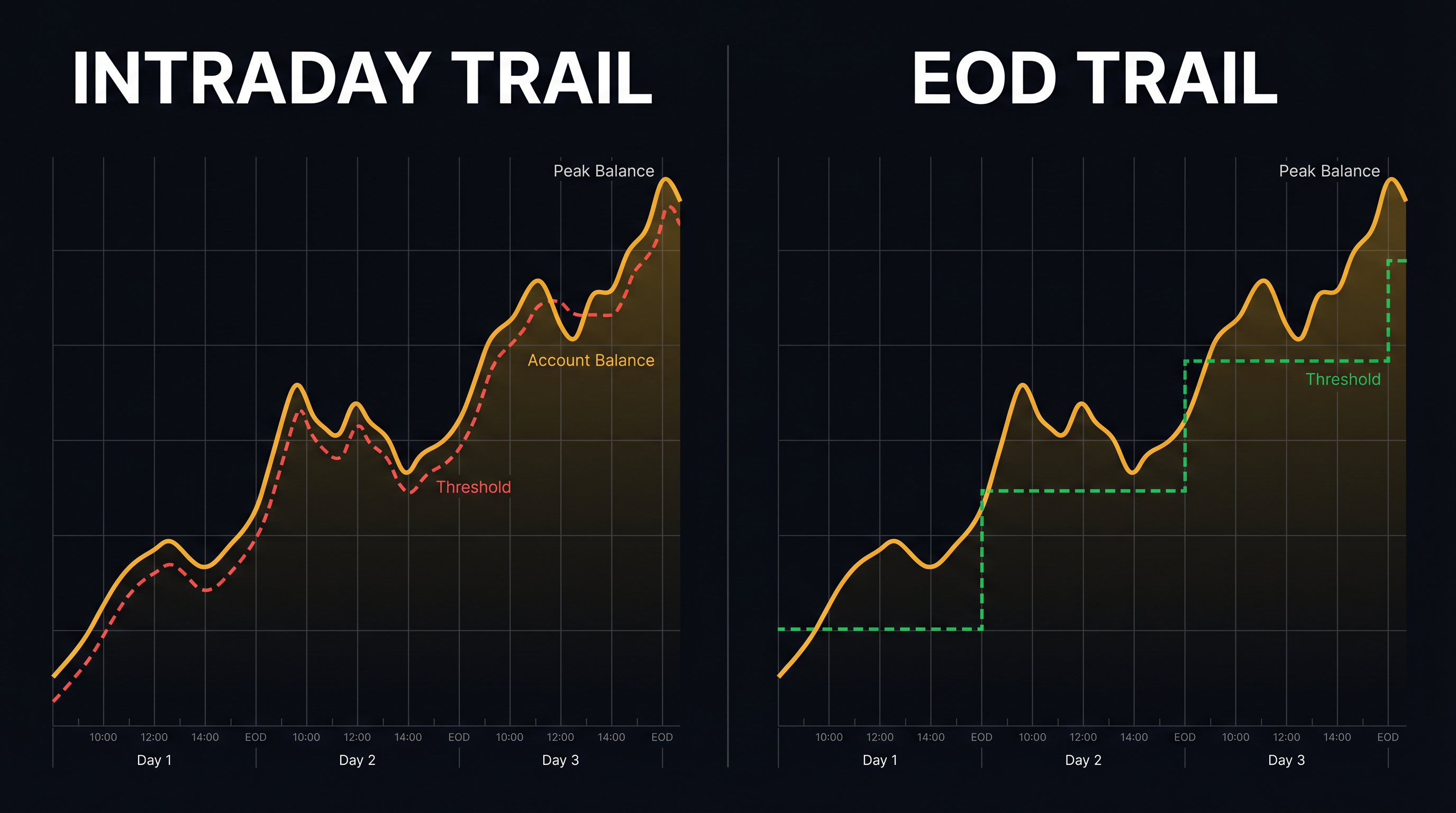
The Intraday Trail adjusts your drawdown threshold in real time based on the account's highest balance during the session, including unrealized gains.
How it works:
- The threshold starts at: starting balance − max drawdown (e.g., $50,000 − $2,000 = $48,000)
- As your account hits new highs (realized OR unrealized), the threshold follows upward
- The threshold never moves down
- If the account balance touches the threshold at any moment, all positions are automatically liquidated
Example, 50K Intraday Evaluation:
- You open a trade and your balance momentarily hits $50,900 on unrealized profit
- New threshold: $50,900 − $2,000 = $48,900
- You close the trade at $50,300 (profit of $300)
- The threshold stays at $48,900, it doesn't move back down
- If your balance ever touches $48,900, the account is breached
When does the trailing stop?
- Evaluation (Rithmic & Wealthcharts): Locks when balance reaches profit target + max drawdown (for the 50K, that's $55,000 → threshold fixed at $53,000)
- Evaluation (Tradovate): Never locks, trails indefinitely
- Performance Account: Locks when threshold reaches starting balance + $100 (for the 50K PA, that's $50,100)
The Intraday Trail is punishing because unrealized PnL counts. If you're in a trade showing $500 in open profit, your drawdown just got $500 tighter even if the trade later goes negative.
End-of-Day (EOD) Trailing Drawdown
The EOD Trail only updates at market close (4 PM CT). Unrealized profit during the day does not move the threshold, only your closing balance matters.
How it works:
- Same starting threshold as Intraday (balance − max drawdown)
- At 4 PM CT, if your closing balance is higher than any previous close, the threshold moves up
- Within the session, the threshold is fixed, you have room to breathe
EOD accounts come with an extra rule: a Daily Loss Limit (DLL).
DLL by account size (Evaluation):
| Account | Daily Loss Limit |
|---|---|
| 25K | $500 |
| 50K | $1,000 |
| 100K | $1,500 |
| 150K | $2,000 |
If your intraday loss hits the DLL, all positions are auto-liquidated and trading pauses until the next session (resets at 6 PM ET). You don't fail the account, you just get locked out for the day.
Which drawdown type should you pick?
| Your style | Pick |
|---|---|
| Scalping, in-and-out quick | Intraday (you rarely carry unrealized profit) |
| Swing, holding winners | EOD (unrealized gains don't bite you) |
| Mean reversion / fading | EOD (you tolerate more heat) |
| You over-trade when chasing | EOD (DLL stops you from revenge-trading to zero) |
| You want maximum flexibility | Intraday (no DLL, no session cap) |
Most experienced Apex traders recommend EOD for anything beyond pure scalping. The Intraday Trail is designed to reward fast, decisive execution, and to punish hesitation.
Supported Trading Platforms
Apex integrates with three platforms. Each one has a different feature set, and your drawdown behavior can vary depending on which one you're on.
Rithmic
The most popular choice among Apex traders. Rithmic is a market data and routing engine, and it works with front-end platforms like NinjaTrader, Quantower, Volumetrica, ATAS, and MotiveWave.
Why traders pick Rithmic:
- Lowest-latency data feed
- Works with virtually every futures front-end
- NinjaTrader connection included at no extra cost ($75 value)
- Real-time CME data fees included ($55 value)
Tradovate
Browser-based and mobile-first. Tradovate handles both the platform and the routing, no separate front-end needed.
Why traders pick Tradovate:
- No software install (runs in browser)
- Mobile app included
- Access to EUREX (DAX, Euro Stoxx, Bunds), Rithmic does not currently route these on Apex
Caveat: On Tradovate evaluations, the intraday trailing drawdown never stops trailing. That's harsher than Rithmic/Wealthcharts.
Wealthcharts
An all-in-one charting and execution platform designed for Apex. Slicker UI than NinjaTrader, built-in indicators, and tighter integration with Apex's dashboard.
Why traders pick Wealthcharts:
- Clean, modern UI
- Indicator library built in
- No separate NinjaTrader license needed
Apex Evaluation Rules (New Accounts)
The evaluation is the simulated challenge you must pass before running a Performance Account. Apex's evaluation is one of the most permissive in the industry.
Profit target
You need to reach the profit target once, at any point during the evaluation. You don't need to close the day above it, you just need to hit it.
- 25K: $1,500
- 50K: $3,000
- 100K: $6,000
- 150K: $8,000
Minimum trading days
1 day. If you hit the profit target in a single session, you pass. No minimum of 5 or 10 days like FTMO.
Time limit
You have 30 days from purchase to pass. After 30 days, the evaluation expires with no reset option on new accounts.
Contract limits during evaluation
| Account | Max mini contracts | Max micro contracts |
|---|---|---|
| 25K | 4 | 40 |
| 50K | 10 | 100 |
| 100K | 14 | 140 |
| 150K | 17 | 170 |
What you can trade
All instruments listed on the Apex instrument sheet: ES, NQ, YM, RTY, CL, GC, 6E, 6B, and dozens more (full list in the "What You Can Trade" section below).
What you cannot do during evaluation
- Hold positions through the 4:59 PM CT daily reset window
- Hold positions through the 5:00 PM CT weekend close (Friday)
- Exceed max contract size at any moment
- Use copy-trading automation across Apex accounts during evaluation (permitted only on PA)
News trading is permitted, Apex does not restrict trading around high-impact economic events.
Performance Account (PA) Rules
After you pass and pay the $85 activation fee, you enter a Performance Account (PA). This is where you earn actual payouts.
50% Consistency Rule
This is the single rule that stops more traders from getting paid than any other.
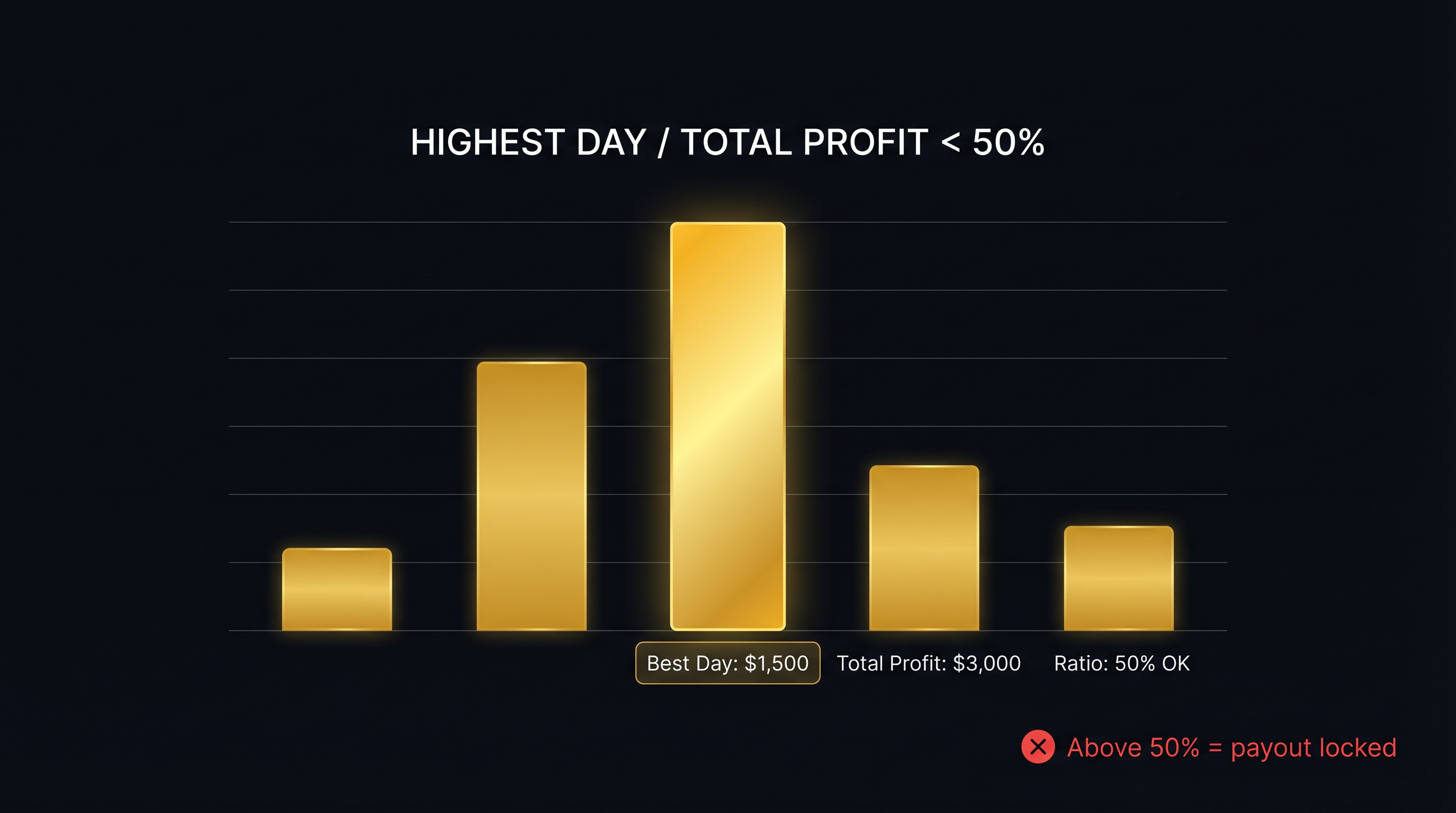
What it means: Your largest profitable trading day cannot exceed 50% of your total accumulated profit at the time you request a payout.
The math:
Highest profit day ÷ Total profit = Consistency %
The result must be below 50% for your payout button to activate.
Example:
- You're on a 50K PA
- Your best day: $1,500 profit
- Your total profit since account start (or last payout): $2,500
Calculation: $1,500 ÷ $2,500 = 60% → payout not available.
To unlock the payout, you need to raise your total profit. The formula is:
Minimum total profit required = Highest profit day ÷ 0.5
So: $1,500 ÷ 0.5 = $3,000 minimum total profit before you can request that payout.
Reset after payout: Once your payout is approved, the consistency calculation resets. Future payouts only count profit earned after the last approved payout.
Losing days don't count. Only profitable days are in the numerator/denominator.
Scaling Tiers and Daily Loss Limit (EOD PAs)
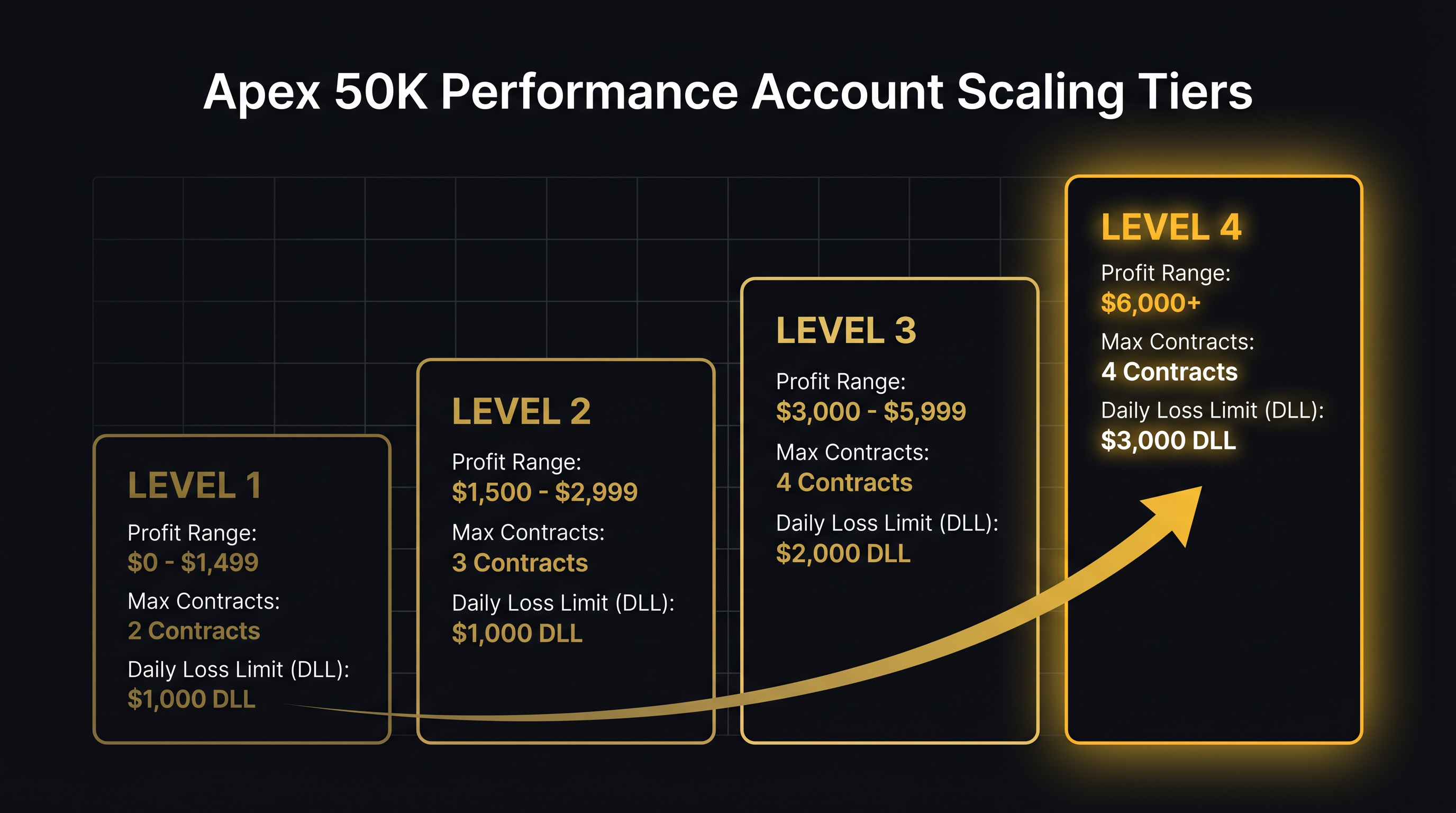
On EOD Performance Accounts, both your max contract size and your Daily Loss Limit scale up as your account grows. This is Apex's "built-in scaling", you don't need to apply for an upgrade.
50K EOD PA tier table:
| Profit range | Max contracts | Daily Loss Limit | Tier |
|---|---|---|---|
| $0 – $1,499 | 2 | $1,000 | Level 1 |
| $1,500 – $2,999 | 3 | $1,000 | Level 2 |
| $3,000 – $5,999 | 4 | $2,000 | Level 3 |
| $6,000+ | 4 | $3,000 | Level 4 |
Max tier for each account size caps the DLL. The 50K caps at $3,000; the 100K caps at $3,500; the 150K caps at $4,000.
Profit split
100% on all simulated funded Performance Accounts. Apex does not take a cut of PA earnings. Your payout is your entire earned balance, subject to:
- Profit must exceed the minimum payout threshold ($500 for the first few payouts)
- Consistency rule must pass
- At least 5 trading days since your last payout (or first trade)
Maximum accounts
You can run up to 20 Apex accounts simultaneously, in any combination of sizes and drawdown types. Each is paid activation separately, and each has its own P&L and rules. Many Apex veterans run 3-5 accounts to diversify risk across strategies or to collect multiple payouts in parallel.
Copy trading on PAs
Apex permits copy trading across your own PAs (not across different traders' accounts). You can run the same strategy on 10 accounts simultaneously via AutoTrader, Copy-AT, or similar tools.
Apex Payout System
Payout frequency
You can request a payout every 5 trading days (business days the CME is open). Your first payout becomes available 5 trading days after your PA activates.
Minimum payout amount
$500 per payout request.
Payout caps on early payouts
The first 5 payouts on a new PA are capped at $1,500 each (for most account sizes). After your 5th approved payout, the cap lifts and you can request your full available balance up to the starting balance safety net.
Safety net
There's a "safety net" built into the PA. Your PA must maintain a minimum balance above the starting balance before any payout can be requested. The safety net scales with account size, roughly starting balance + $2,600 for the 50K. Consult the Apex FAQ for the exact figure at time of payout.
Payout methods
| Method | Speed | Fees |
|---|---|---|
| Plane (ACH) | 1–3 business days | Low |
| Wise | 1–2 business days | Varies by country |
| Wire transfer | 3–5 business days | Bank fees apply |
Apex has a track record of paying, the Trustpilot review base of 19,000+ entries is dominated by positive payout confirmations. Delays do happen (usually 2–7 business days during high-volume weeks), but outright denials are rare on the new program. Apex explicitly advertises "No Payout Denials" in its branding, and the operational model supports that claim on well-structured accounts.
Maximum payout requests per PA
A new PA has a cap of 6 payout requests. After the 6th, if the account is healthy, Apex may move you to their live trading program, where there is no payout cap.
What You Can Trade on Apex
All contracts are CME Group or EUREX. Full list of frequently traded instruments:
Equity index futures
- E-mini S&P 500 (ES), $50 per point
- Micro E-mini S&P 500 (MES), $5 per point
- E-mini Nasdaq-100 (NQ), $20 per point
- Micro E-mini Nasdaq-100 (MNQ), $2 per point
- Mini-Dow (YM), $5 per point
- Micro Dow (MYM), $0.50 per point
- Russell 2000 (RTY), $50 per point
- Micro Russell (M2K), $5 per point
Energy
- Crude Oil (CL), $1,000 per point
- Micro Crude (MCL), $100 per point
- Natural Gas (NG), $10,000 per point
- E-mini Natural Gas (QG), $2,500 per point
Metals (availability varies, currently restricted on some COMEX contracts)
- Gold (GC), $100 per point
- Micro Gold (MGC), $10 per point
- Silver (SI), $5,000 per point
Currencies
- Euro FX (6E), British Pound (6B), Japanese Yen (6J), Canadian Dollar (6C), Australian Dollar (6A), Swiss Franc (6S)
Agricultural
- Corn (ZC), Soybeans (ZS), Wheat (ZW), Soybean Meal (ZM), Soybean Oil (ZL)
Crypto (micros only)
- Micro Bitcoin (MBT), Micro Ethereum (MET)
EUREX (Tradovate only)
- DAX (FDAX), Mini-DAX (FDXM), Euro Stoxx 50 (FESX), Euro-Bund (FGBL)
Apex Trader Funding: Pros & Cons
Pros
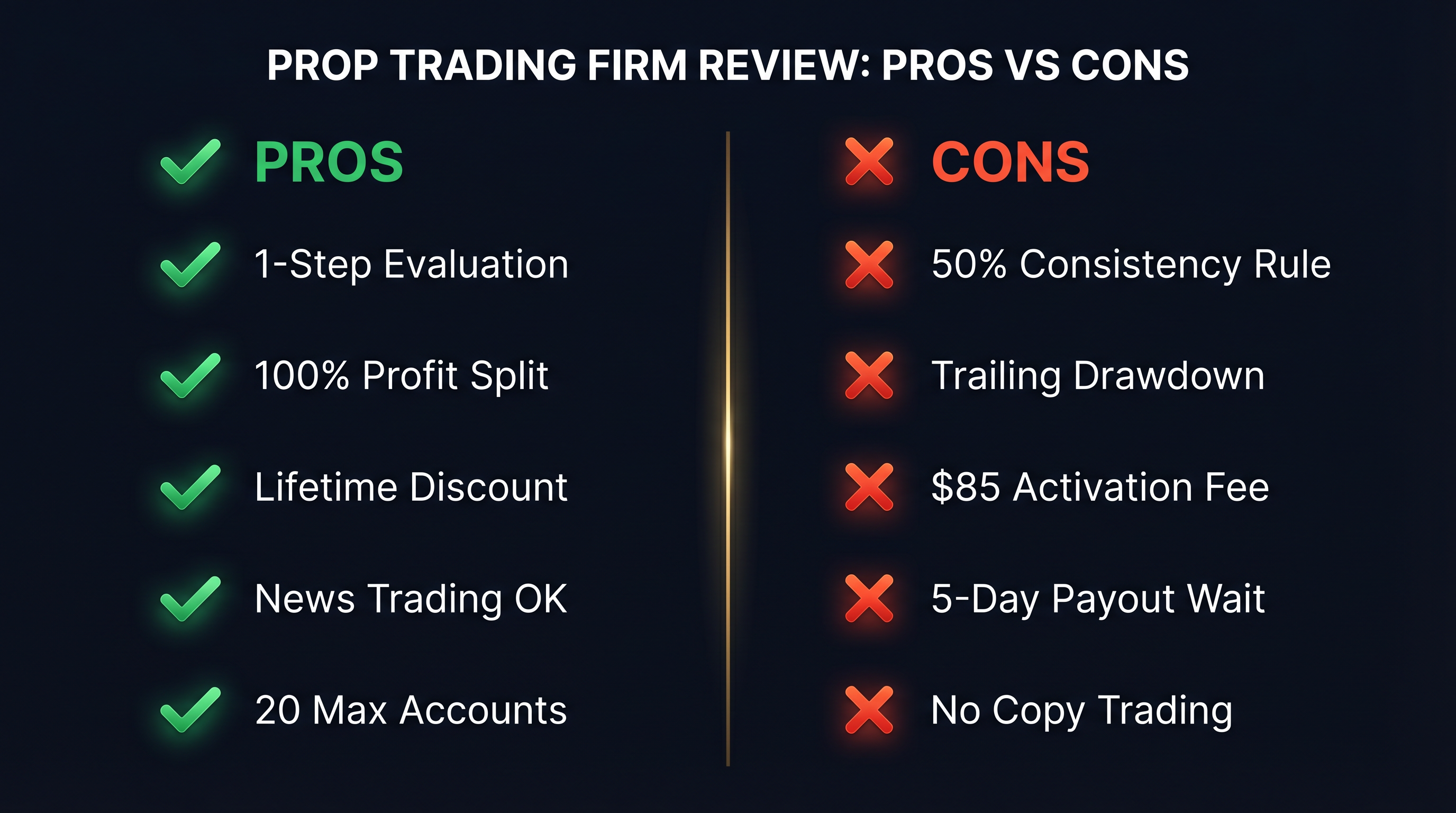
- Lifetime discount via the MARKET coupon, roughly 90% off every purchase, not a first-order promo
- 100% profit split, no cut taken on PA earnings
- Fastest-to-fund: Pass in 1 day minimum, activate same day
- No time minimum to hold trades, scalpers are fine
- News trading permitted, no rule against trading NFP, FOMC, or CPI
- Up to 20 accounts per trader, scale horizontally
- Platform choice: Rithmic, Tradovate, or Wealthcharts
- Track record of payouts: Averaging over $1M/month to customers since 2023
- No ongoing subscription, evaluation fee and activation fee are both one-time
Cons
- Intraday Trailing Drawdown is unforgiving, unrealized PnL counts, and once you breach you're out with no refund
- 50% consistency rule locks payouts, a single big winning day can delay payouts for weeks
- No reset option on new accounts, one breach costs you the full evaluation fee
- 30-day evaluation window, shorter than the industry-standard "unlimited time"
- First 5 payouts capped at $1,500, reaching large payouts takes time
- Safety net slows early payouts, minimum PA balance must be maintained
- Legacy vs new dual system can confuse, accounts bought before March 1, 2026 follow different rules
- Limited instrument list during COMEX restrictions, metals availability fluctuates
Who Is Apex Best For?
Apex is the right firm for you if you fit one of these profiles:
1. Active futures scalper on ES, NQ, or CL The 1-day pass minimum, permissive news policy, and tight-but-fair drawdown math reward fast, high-frequency traders.
2. Swing trader with multi-account strategy Run 5 EOD 50K accounts, use the built-in scaling to grow each, and collect parallel payouts every 5 trading days.
3. Price-sensitive trader starting out The $19.90 entry with MARKET is the cheapest serious entry point in futures prop trading. You can budget your first 3–4 evaluation attempts for under $80 total.
4. Trader who wants no split Most firms take 10–25% of PA profits. Apex's 100% split on simulated funded accounts is the highest you'll find.
Who should look elsewhere:
- If you prefer forex or CFDs, Apex doesn't offer them, consider FTMO or FundingPips instead
- If you want an unlimited time evaluation, consider Take Profit Trader (no time limit)
- If the Intraday Trail feels too punishing, pick Apex EOD or try Bulenox's static drawdown model
Apex vs Other Prop Firms
Apex vs FTMO
FTMO is forex-focused, with a 2-step evaluation, 80% profit split, and $155 entry for the 10K account. Apex is futures-only, 1-step, 100% split, $19.90 entry (with MARKET). If you trade futures, Apex wins on price and split; FTMO wins if you need forex.
Apex vs Bulenox
Bulenox offers similar futures evaluation mechanics but with a static drawdown option, no trailing threshold at all. If the Apex Intraday Trail has burned you, Bulenox's static drawdown is worth testing. Bulenox tends to have higher profit targets.
Apex vs Take Profit Trader
Take Profit Trader (TPT) offers unlimited evaluation time and a similar 1-step structure. TPT tends to have stricter consistency rules (often 40%) but no time pressure. Good alternative if you struggle with the 30-day Apex clock.
Apex vs Earn2Trade (E2T)
E2T has a "Gauntlet" evaluation (15 trading days minimum) and an 80% profit split. More conservative and methodical. Apex is faster and cheaper per account.
Frequently Asked Questions
Is Apex Trader Funding legit?
Yes. Apex has been operational since 2019, is rated 4.4/5 on Trustpilot across 19,000+ reviews, and publishes monthly customer payout totals (averaging over $1M per month since January 2023). It is one of the most established futures prop firms in the U.S.
How much does Apex Trader Funding cost?
Entry starts at $19.90 for the 25K account when using the MARKET coupon (90% off the $199 regular price). After passing the evaluation, you pay a one-time $85 activation fee to move to a Performance Account. No recurring billing.
What is the Apex consistency rule?
The 50% consistency rule means your single largest profitable trading day cannot exceed 50% of your total accumulated profit at the time of a payout request. If it does, the payout option is locked until your total profit grows enough to lower the ratio below 50%.
How long does it take to pass the Apex evaluation?
The minimum is 1 trading day. The maximum is 30 days from evaluation purchase. Most traders pass within 5–15 trading days.
Does Apex pay out?
Yes. Apex releases payouts on a 5-trading-day cycle. Average processing time is 2–5 business days after approval. The firm publishes total customer payouts and has paid over $100 million cumulatively since 2022.
What is the Apex profit split?
100% on Performance Accounts (simulated funded). Apex does not take a cut of your PA earnings, only the one-time activation fee.
Can I trade news on Apex?
Yes. Apex does not restrict news trading. You can trade NFP, CPI, FOMC, or any high-impact event.
What platforms does Apex support?
Three platforms: Rithmic (works with NinjaTrader, Quantower, ATAS, MotiveWave), Tradovate (browser-based), and Wealthcharts (all-in-one).
Can I copy trade across Apex accounts?
Yes, on Performance Accounts. You can run the same strategy on up to 20 PAs via AutoTrader, Copy-AT, or similar tools. Copy trading is not permitted during the evaluation phase.
What happens if I breach my Apex evaluation?
The account fails immediately and all open positions are liquidated. On new accounts (post-March 1, 2026), there is no reset option, you must purchase a new evaluation to try again. Legacy accounts can still be reset for $80.
Is there a time limit on Apex Performance Accounts?
No. As long as you don't breach the drawdown and you stay active (Apex has an inactivity policy, so don't let the account sit dormant for extended periods), the PA stays open indefinitely.
What is the activation fee for?
The $85 activation fee covers the setup of your Performance Account after evaluation pass: data fees, platform licensing (Rithmic/Tradovate), and PA infrastructure. It is paid once per PA, not recurring.
How to Get Started with Apex Trader Funding
Follow these steps to minimize your cost and maximize your chance of passing:
Step 1: Use the MARKET affiliate link
Go to apextraderfunding.com via our affiliate link. This ensures the MARKET coupon is pre-applied and stays linked to your account for every future purchase (lifetime discount).
Step 2: Pick your account size
For a first evaluation, most traders should start with the 50K account, it offers a balanced contract limit, a $3,000 profit target that's reachable in 5–10 trading days, and a $2,000 max drawdown that gives breathing room.
Step 3: Choose drawdown type
- Scalpers and intraday momentum traders: Intraday Trail
- Swing traders or anyone carrying positions through the day: EOD Trail
Step 4: Choose platform
- NinjaTrader user: Rithmic
- Browser/mobile user: Tradovate
- All-in-one preference: Wealthcharts
Step 5: Enter the MARKET coupon at checkout
Confirm that the discount shows (should drop your 50K price from $249 to $24.90). Complete the purchase.
Step 6: Pass the evaluation
Focus on one instrument (ES, NQ, or MES are the most common). Hit the profit target with consistent, modest gains rather than one oversized session, this positions you to meet the 50% consistency rule when you request your first payout.
Step 7: Pay the $85 activation fee within 7 days
Miss this window and you lose the pass. Don't delay.
Step 8: Trade the PA for your first payout
Minimum 5 trading days from activation. Keep your largest day under 50% of total profit. Request payout when both conditions are met.
Final Verdict
Apex Trader Funding is the default choice for most new futures traders in 2026, and for good reason: the lifetime MARKET discount makes it the cheapest serious entry into funded futures trading, the 100% profit split is unbeatable, and the 5-trading-day payout cycle is one of the fastest in the industry.
The two rules that matter are the intraday trailing drawdown (pick EOD if you hold positions for more than a few minutes) and the 50% consistency rule (size your days to stay below 50% of your running total). Understand both, and Apex is one of the cleanest paths to a funded account and regular payouts.
For traders comparing options, Apex's combination of price, split, and track record is difficult to match. The main watch-outs are the no-reset policy on new accounts, the 30-day evaluation clock, and the early payout caps, none of which are deal-breakers if you budget for them.
Ready to start? Use the code MARKET at Apex Trader Funding for 90% off your evaluation.
Related Guides on Markets Coupons
- Bulenox Review: Static Drawdown Alternative
- FTMO vs Apex: Forex vs Futures Prop Firms
- How to Pass Any Prop Firm Evaluation
- Prop Firm Calculator: Position Size by Account Size
- Compare All Prop Firms