What is a Prop Firm? Complete Guide 2026 (How It Works, Is It Worth It?)
Last updated: April 20, 2026, 14 min read
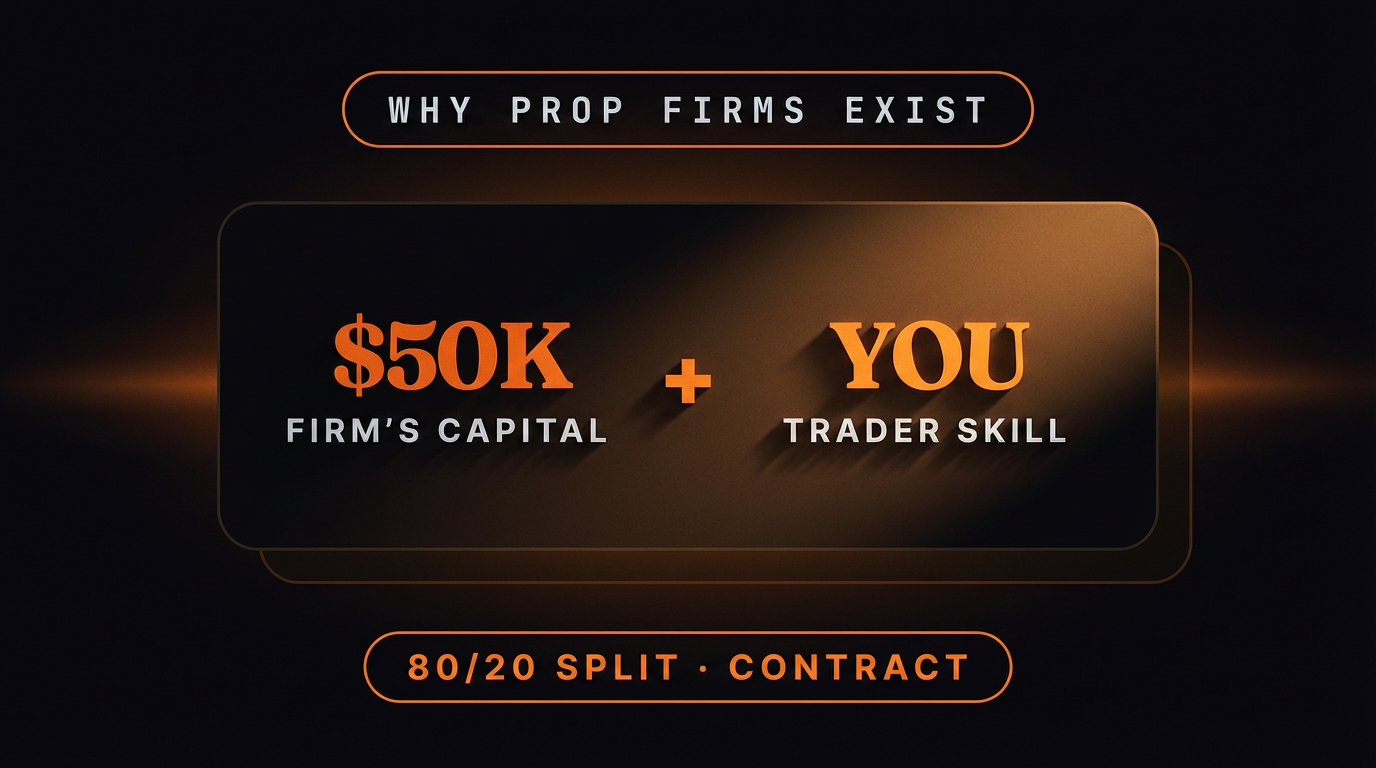
TL;DR, A Prop Firm (proprietary trading firm) is a company that provides simulated capital for traders to operate, after they pass a paid evaluation. The trader keeps 80% to 100% of the profits (Profit Split), and the firm assumes the operational risk. The sector moves over US$ 3 billion per year in evaluation fees and pays over US$ 50 million per month to traders who pass. Less than 10% of traders pass on their first attempt. This guide explains every part of the model, from the day you pay for the challenge until the day the money lands in your account.
| Industry Numbers (2026) | |
|---|---|
| Estimated Market Size | US$ 3 billion/year in fees |
| Aggregated Monthly Payouts | US$ 50 million+ to traders |
| Active Firms Worldwide | Over 180 |
| Estimated Pass Rate | Between 5% and 12% on 1st attempt |
| Countries with Most Traders | USA, Brazil, India, Pakistan, Indonesia |
| Dominant Models | Futures (CME) and Forex (CFD) |
| Average Entry Ticket | US$ 20–US$ 200 with coupon |
| Standard Profit Split | 80% (Forex) to 100% (Futures) |
Definition: What is a Prop Firm
A Prop Firm is a proprietary trading company that grants trading capital to independent traders, charging an initial evaluation fee. The name comes from proprietary trading, meaning the company trades with its own money, not with external client money like a bank or a traditional brokerage.
In the modern model, which consolidated from 2019, the firm does not fund the trader with real capital on day one. It creates a simulated account with a theoretical balance (US$ 25,000, US$ 50,000, US$ 100,000, or US$ 150,000), and observes the trader's performance in this environment. When the trader meets the challenge goals, without violating Drawdown, consistency, and management rules, they move to a "funded" account, which remains simulated, but where all generated profit is replicated by the firm's desk with real capital and paid to the trader.
In practice, the modern Prop Firm is a statistical talent filter: it charges a low price (US$ 20–US$ 600) to test thousands of traders per month, identifies the few who can be consistently profitable, and monetizes the payouts of these few by operating the aggregated book itself.
Why this model exists
Before retail Prop Firms, a retail trader had two paths to operate: put up their own capital, with all the risk and little leverage, or try for a position at a traditional Wall Street proprietary desk (Jane Street, Jump Trading, DRW), where the entry barrier is a quantitative degree and a months-long technical test. Retail Prop Firms created a third way: pay US$ 20 to prove you know how to trade, and in return access much larger capital than you would have alone.
For the firm, the model works because the distribution of trading results is extremely asymmetrical. Most traders fail quickly, and the fees paid by this group subsidize the payouts of the small group that performs. It's a structure similar to an insurance company: many small contracts paid, few large claims.
A bit of history: from Wall Street
The concept of proprietary trading is almost a century old. Investment banks like Salomon Brothers and Goldman Sachs maintained proprietary desks as early as the 1970s and 1980s, trading their own capital in arbitrage, market making, and directional risk. In parallel, purely proprietary firms like Susquehanna, Jane Street, and DRW emerged, which never sold anything to clients, they exist solely to trade their own money.
In 2010, the Dodd-Frank regulation (Volcker Rule) forced banks to separate or close their prop desks. Many experienced traders moved to independent firms. This created an ecosystem of institutional proprietary desks that hired traders through extremely rigorous selection processes.
The retail revolution came in two waves:
- Wave 1 (2015–2018): FTMO (founded in 2014 in Prague) popularizes the paid evaluation model. TopStepTrader does the same for Futures. The concept of a "challenge coupon" did not yet exist.
- Wave 2 (2020–2024): The explosion of retail traders during the pandemic inflated the sector. Firms like Apex Trader Funding (2019), FundedNext (2022), and FundingPips (2022) brought aggressive pricing, Lifetime coupons, and high-frequency payouts.
Today, in 2026, Brazil is the second-largest consumer market for Prop Firms after the USA, ahead of India and Pakistan, according to aggregated website traffic data from the main firms.
How it works, step by step
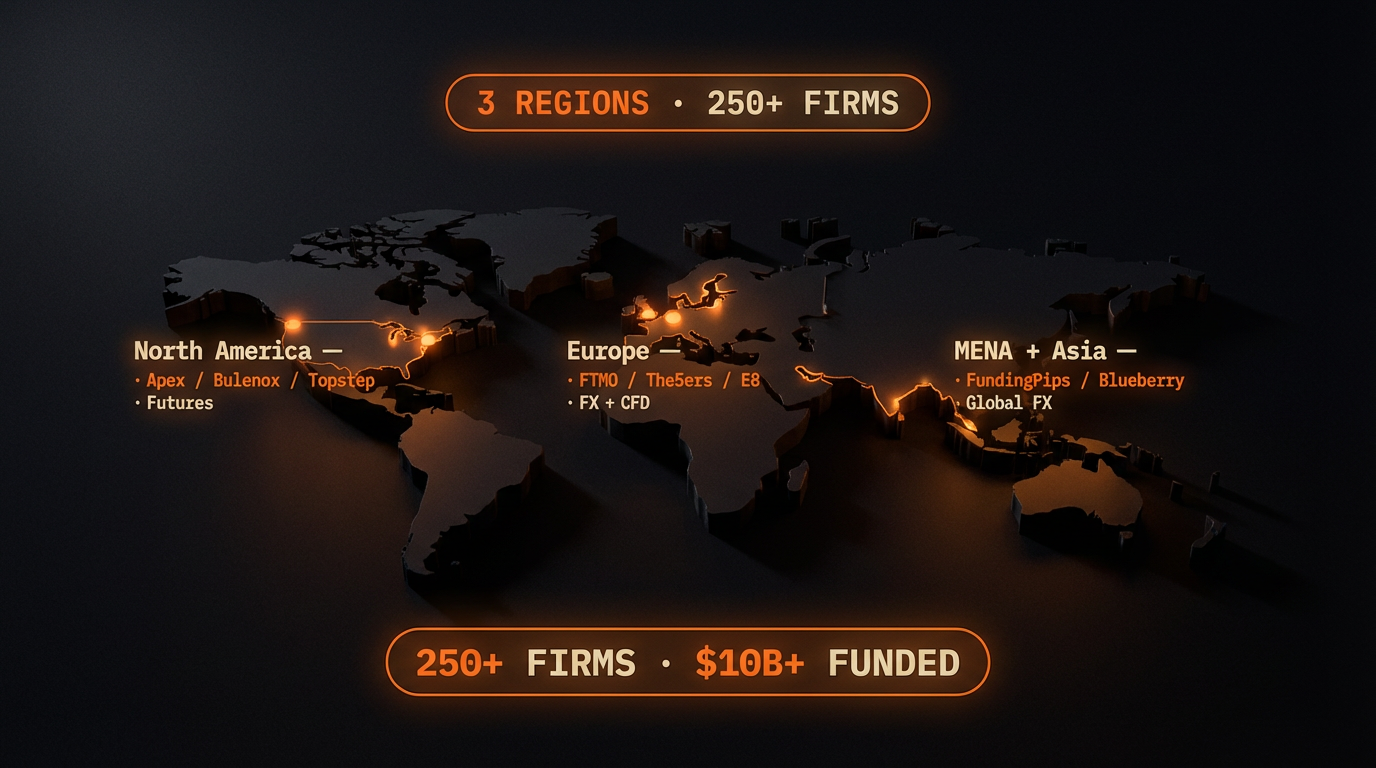
The standard flow of a modern Prop Firm has four steps. Understanding each one before paying for any challenge is what separates those who make money from the group stuck in infinite resets.
Step 1: Evaluation purchase (challenge)
You choose a simulated account size (e.g., US$ 50,000), a platform (Rithmic, Tradovate, MetaTrader 5, cTrader), and pay an entry fee. With a coupon, this fee ranges from US$ 19 (Apex 25K with MARKET) to US$ 150 (FTMO 100K with seasonal discount). Without a coupon, the same challenge costs 5 to 10 times more.
This fee is not refunded if you fail. It's what sustains the firm's model. If you pass, most firms refund the fee along with the first withdrawal (conditional refund).
Step 2: The evaluation
You operate the simulated account trying to reach a profit target, usually 8% to 10% of the initial balance, without violating rules. The most common rules:
- Daily Loss Limit, a daily loss ceiling (e.g., -US$ 1,500 per day)
- Max Drawdown, a total accumulated loss ceiling (e.g., -US$ 2,500 per cycle)
- Min Trading Days, minimum trading days (1 to 5, depending on the firm)
- Consistency Rule, your largest profitable day cannot represent more than 30% to 50% of the total profit
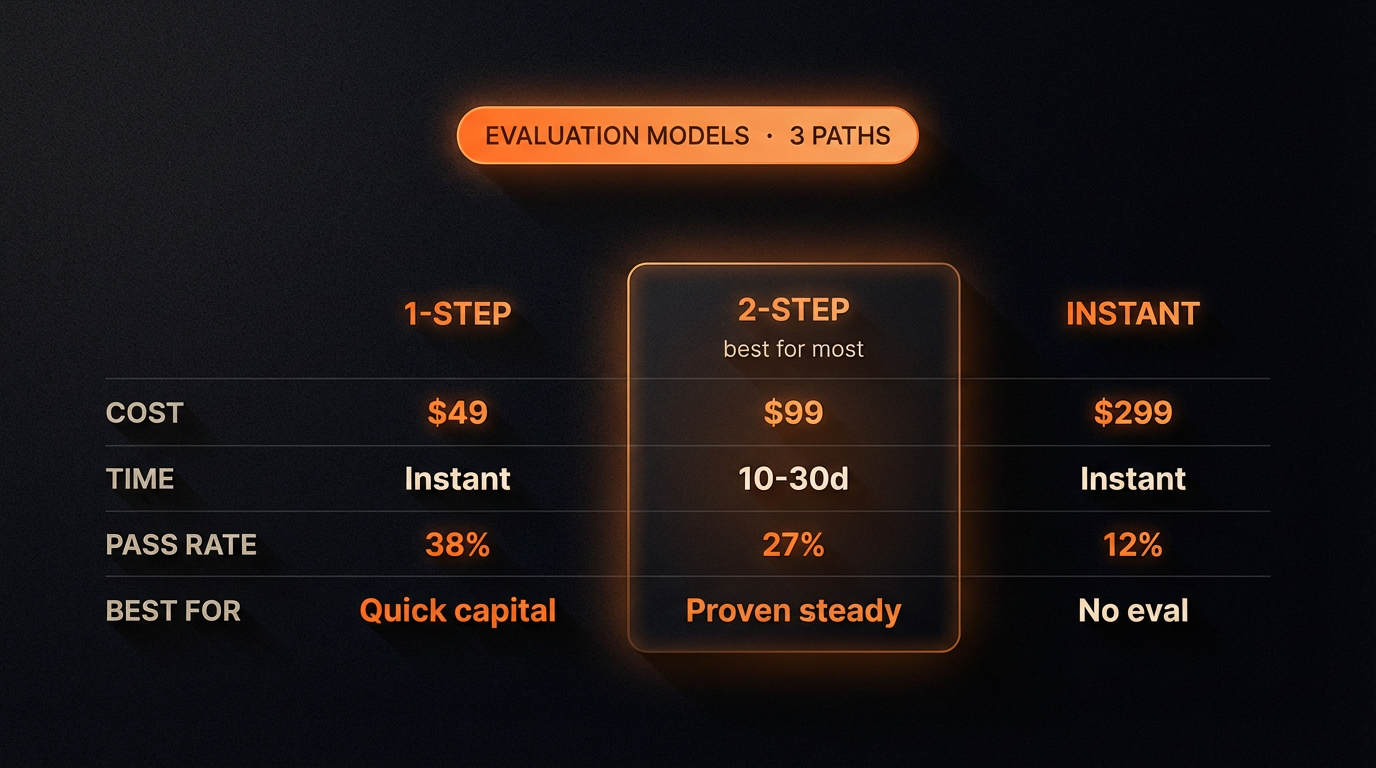
Depending on the firm, the challenge can be 1-step (Apex, TPT), 2-step (FTMO, FundedNext), or instant-funding (Bulenox). Each format has different trade-offs, which we explore in the guide How to Pass the Challenge.
Step 3: The funded account (PA)
Passed the evaluation? You gain access to a Performance Account (PA), still simulated, but with a different status. Some firms charge an activation fee for this transition (Apex: US$ 85 once; FTMO: no fee), and you start trading aiming to generate payouts.
In the PA, Drawdown limits still apply, but you now have a main objective: accumulate enough profit to request the first withdrawal, respecting minimum windows (e.g., 5 trading days in Apex, 14 days in FTMO).
Step 4: Payout
When the minimum cycle ends and the profit is within the consistency rule, you request the withdrawal. The firm processes it in 2 to 5 business days via ACH, Rise, Deel, or Wise, depending on your country. The amount paid is your profit multiplied by the Profit Split: 80% in most Forex firms, 90% in intermediate firms, and 100% in Apex and Pro versions of other firms.
The first payout is when the model "closes", you recover the evaluation fee, the activation fee, and leave with net profit. From then on, each cycle is pure margin. The guide How to Withdraw Your Profits details the payment flows.
The two dominant models: Futures vs Forex/CFD
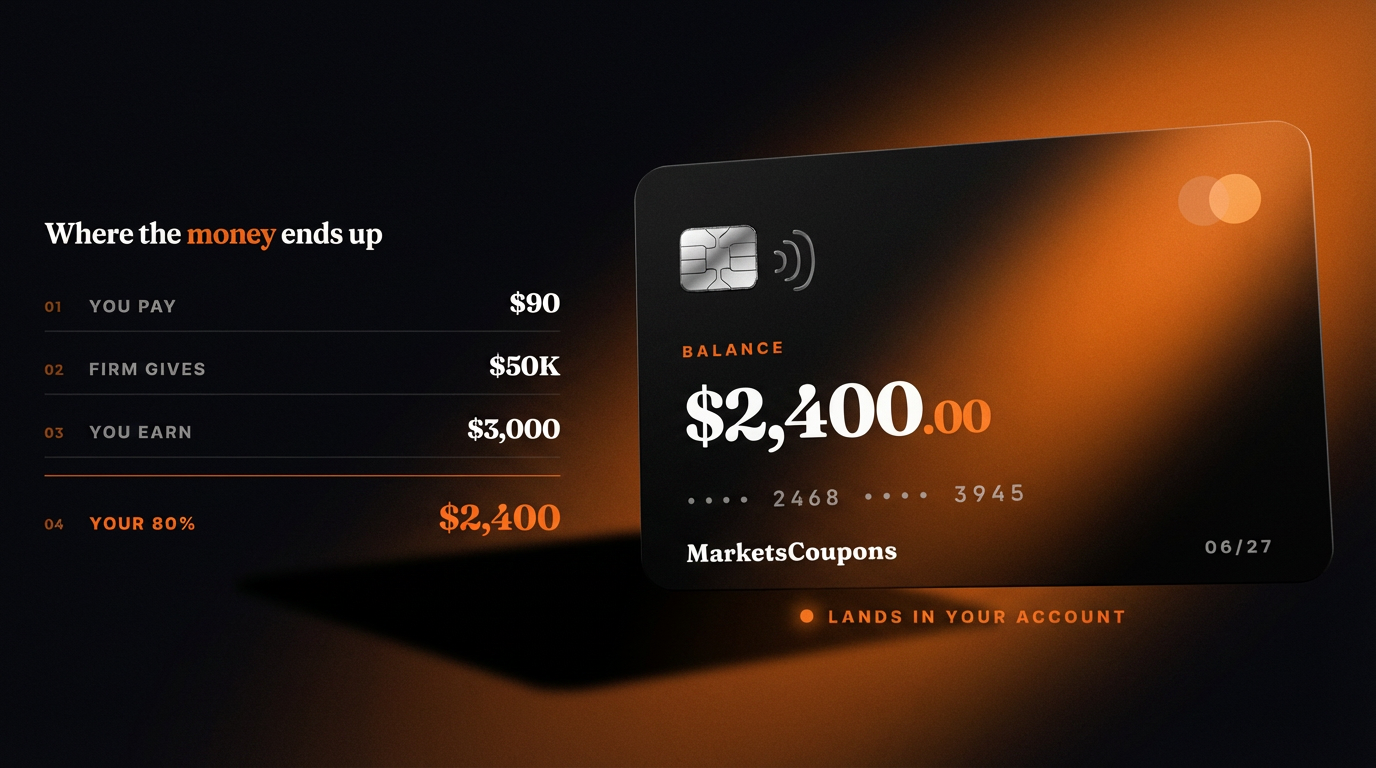
In 2026, the Prop Firms market is divided into two main families. It's not just a matter of asset, the technical infrastructure, regulatory environment, and trader profile attracted by each are different.
Futures Prop Firms
They focus on contracts listed on the CME Group (Chicago Mercantile Exchange): ES (S&P 500), NQ (Nasdaq 100), GC (Gold), CL (WTI Crude Oil), ZN (10-Year Treasury), 6E (Euro FX), among others. Execution occurs via institutional routers: Rithmic, CQG, Tradovate. Liquidity is real, you trade against the aggregated exchange book, not against an internal firm desk.
The main firms in this model are Apex Trader Funding, Bulenox, TakeProfitTrader, and Earn2Trade. All are based in the USA and operate under a stricter regulatory framework, as Futures contracts are regulated by the CFTC (Commodity Futures Trading Commission).
Futures Advantages: known price per contract (each ES tick is worth US$ 12.50), clear market hours, no artificial spread, minimal slippage during liquid hours, Profit Split of 90% to 100%. Additional cost: you pay a small monthly data fee to the CME (around US$ 95 for retail real-time, often covered by the firm).
Forex and CFD Prop Firms
They trade currency pairs (EURUSD, GBPUSD, USDJPY), CFD indices (SPX500, NAS100, GER40), metals (XAUUSD, XAGUSD) and, in some firms, cryptos and CFD stocks. Execution occurs via MetaTrader 4/5 or cTrader, on the firm's own servers or those of liquidity providers.
The main firms in this model are FTMO, FundedNext, FundingPips, The5%ers, BrightFunded, and E8 Markets. Most are based in Europe (Czech Republic, United Arab Emirates, United Kingdom) and operate in an environment with less specific regulation, CFDs are regulated by the FCA in the UK and the DFSA in the Emirates, but the Prop Firm model itself is not considered a traditional financial service.
Forex Advantages: 24/5 market, higher leverage (up to 1:100 in some plans), exotic pairs available, variable spreads. Attention: many firms operate on a B-Book model, meaning the trader trades against the firm itself, not against external liquidity. This is neither illegal nor fraud, but it changes the economic incentive: the firm wants the trader to lose, because the trade is the counterparty.
Which model is best for you
The choice depends on three factors: time zone, risk profile, and asset preference.
- If you are Brazilian and want to trade during American hours (10:30 AM to 5 PM in Brazil): Futures fits better. The liquidity of the S&P 500 and Nasdaq is unbeatable between 10:30 AM and 12 PM (NY open) and from 3 PM to 5 PM (Power Hour).
- If you need to trade outside business hours: Forex makes more sense. The market is liquid 24 hours between Sunday night and Friday afternoon.
- If you want the highest Profit Split: Futures. Apex pays 100%, no split with the firm.
- If you want maximum leverage and volatility in exotic pairs: Forex.
How the Prop Firm really makes money
Understanding a Prop Firm's revenue streams is critical to distinguish healthy firms from schemes that will close in 12 months. There are four main revenue streams:
1. Evaluation fees (80% of typical revenue)
Fee paid by each trader who buys a challenge. It's recurring revenue because most traders fail and buy again (reset). An average firm earns more from resets than from initial purchases.
2. Activation fees and monthly fees
Some firms charge a one-time fee to activate the funded account (Apex: US$ 85). Others charge a monthly fee (e.g., FundedNext Stellar: US$ 80/active month). This revenue covers infrastructure and audit costs.
3. Internal spread and B-Book execution (Forex)
In Forex firms, part of the profit comes from the spread between the price paid to the trader and the real price of the liquidity provider. When the trader loses, the firm keeps the money. When the trader wins, the firm pays from its internal desk, ideally offsetting with other traders who lost on the same pair.
4. Spread pass-through and data fees (Futures)
In Futures, as execution is real, the firm does not profit from the spread. It earns small margins on data fees, commissions passed on from the broker (Rithmic, Tradovate), and eventually with a desk overlay, its own trading desk that operates the aggregate of funded traders.
The question every trader asks: "If the firm depends on my failure, why would I trust it?". Answer: because large firms have already moved past the "profiting from failure" stage. Apex, FTMO, and FundedNext profit stably by selling challenges to thousands of new traders each month. A trader who passes and generates US$ 5,000 in payout is a living marketing piece, not a financial threat.
Who's who in the ecosystem
A Prop Firm operation involves several parties that are not always explicitly visible to the trader:
| Party | What it does |
|---|---|
| Prop Firm | Company that sells challenges, defines rules, processes payouts |
| Broker / Clearing | Tradovate (Futures), Eightcap, Purple Trading (Forex), executes orders |
| Data vendor | Rithmic, CQG, provides real-time market quotes |
| Platform | NinjaTrader, TradingView, MetaTrader 5, interface where the trader operates |
| Liquidity provider | Banks and prime brokers that provide prices (mainly in Forex) |
| Auditor | In some firms, independent auditors validate reported payouts |
| Payment processor | Rise, Deel, Wise, ACH, sends money to the trader |
This map matters because each link in this chain represents a point where things can go right or wrong. Healthy firms work with established partners (Tradovate is controlled by NinjaTrader; Rithmic is used for billions in volume daily). Suspicious firms often have opaque chains or unknown partners.
The matrix of main firms (April 2026)
There are over 180 active Prop Firms in 2026. The vast majority have marginal volume. The sector concentrates 80% of payouts in about 12 firms. Here is the map of the main ones, by segment.
| Firm | Type | Profit Split | Trustpilot | Minimum entry (with coupon) |
|---|---|---|---|---|
| Apex Trader Funding | Futures | 100% | 4.4 / 19k reviews | US$ 19.90 (25K) |
| Bulenox | Futures | 100% | 4.5 / 5k reviews | US$ 35 (25K) |
| TakeProfitTrader | Futures | 90% | 4.7 / 7k reviews | US$ 75 (25K) |
| Earn2Trade | Futures | 80% | 4.6 / 4k reviews | US$ 71 (25K) |
| FTMO | Forex/CFD | 80–90% | 4.8 / 16k reviews | US$ 155 (100K) |
| FundedNext | Forex/CFD | 80–95% | 4.5 / 20k reviews | US$ 49 (5K) |
| FundingPips | Forex/CFD | 80–90% | 4.7 / 13k reviews | US$ 29 (5K) |
| The5%ers | Forex/CFD | 80–100% | 4.7 / 7k reviews | US$ 39 (10K) |
| BrightFunded | Forex/CFD | 80–90% | 4.8 / 3k reviews | US$ 48 (5K) |
| E8 Markets | Forex/CFD | 80% | 4.6 / 6k reviews | US$ 38 (5K) |
| City Traders Imperium | Forex/CFD | 70–100% | 4.7 / 8k reviews | US$ 29 (10K) |
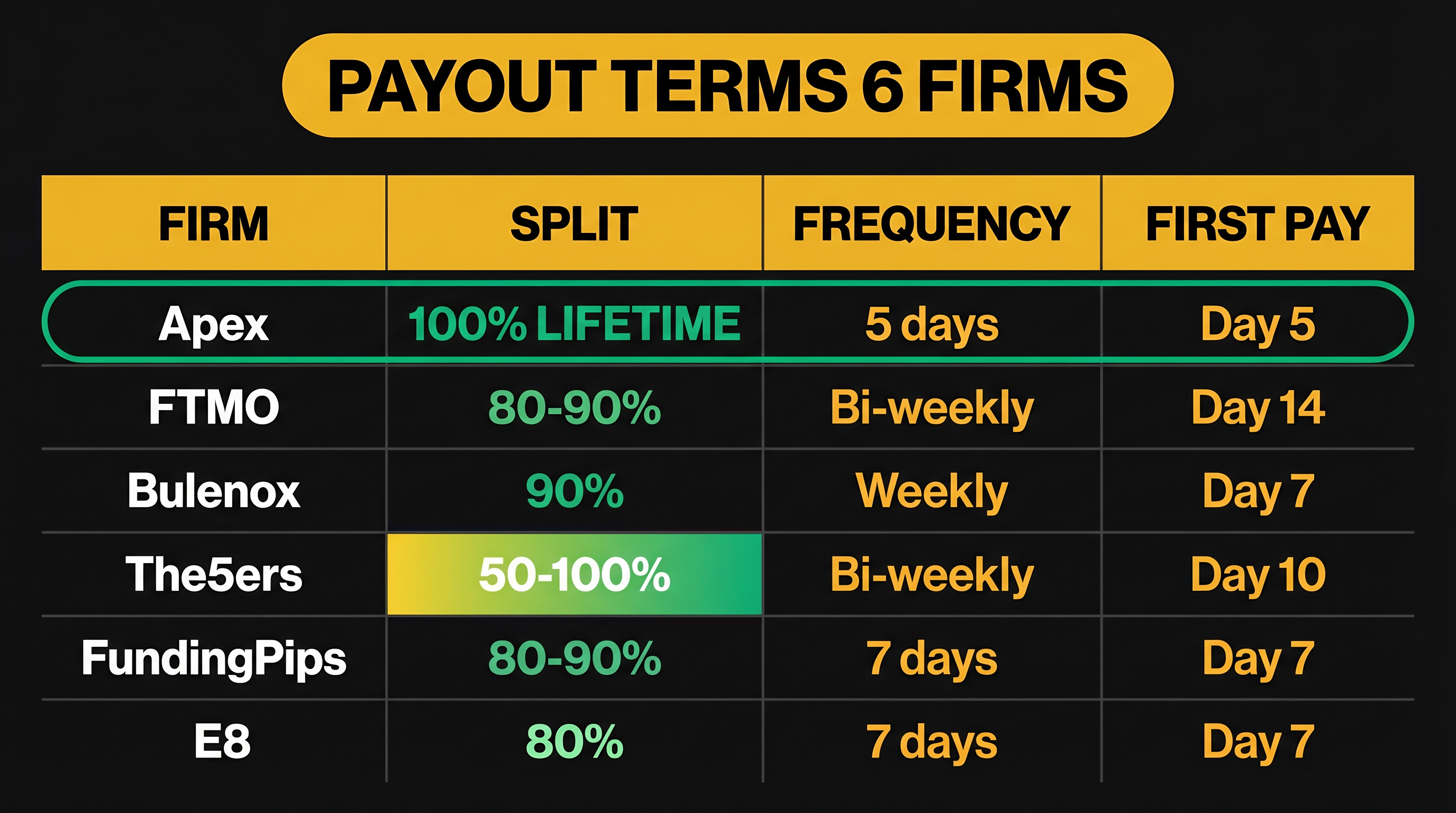
See the complete list updated with active coupons for real-time prices.
Advantages vs trading with own capital
The argument for Prop Firms is mathematical. Consider two scenarios for a beginner trader with US$ 2,000 in their own capital:
Scenario A: Trader operates own capital
US$ 2,000 in a real account. Even risking 1% per operation (US$ 20), the average gain on a good Futures day is small, an ES operation capturing 5 points with 1 contract yields US$ 62.50. Problem: each ES contract requires intraday margin of US$ 500–US$ 2,000 depending on the broker, meaning you can barely trade 1 lot. And if you have a bad day of -US$ 400, you've lost 20% of your real capital.
Scenario B: Trader uses a Prop Firm
The same US$ 2,000 pays for 10 Apex 50K evaluations (US$ 100 each with a coupon). Even with a 90% failure rate, if 1 out of 10 challenges passes, they enter a simulated account with the power to trade 2 to 5 ES contracts. A month with a net profit of US$ 3,000 in the funded account, deducting a 100% Profit Split in Apex, results in US$ 3,000 in their pocket, a return 30 times the amount they paid for the challenge.
It is this math that sustains the model's appeal. The firm's capital replaces the capital you don't have, in exchange for a performance filter that eliminates inconsistent traders. You pay a "performance subscription": prove you know how to trade, and gain free leverage.
Compared advantages (summary)
- Effective leverage, trade US$ 50k–US$ 150k spending US$ 20–US$ 200
- Defined maximum risk, loss is capped at the challenge value, never at personal capital
- No margin call, you don't need to deposit more if you lose
- High Profit Split, 80% to 100% of profit stays with you
- Fast Payouts, cycles of 5 to 14 days, versus months of accumulation with own capital
- Multiple accounts, Apex allows up to 20 simultaneous accounts, multiplying payout potential
The real risks (and pitfalls)
The model is not without problems. Before joining, you need to understand the five main risks.
1. The challenge is a sunk cost
Fees paid are not refunded if you fail. 90% of traders fail on their first attempt. Many enter an infinite reset cycle, each reset costs US$ 80–US$ 150 and maintains the illusion that "this time it will work." Practical rule: if after 3 resets you are no closer to passing, the problem is technical, not luck.
2. Silent rules
Trailing Drawdown that only freezes after reaching profit (Apex), 30% Consistency Rule (some firms), payout windows that require 14 trading days, these are rules many traders only discover when it's time to withdraw. Read the firm's complete documentation before paying. The guide Drawdown Management breaks down the types of DD that most often disqualify traders.
3. Firm closure
In 2022 and 2023, several smaller firms went bankrupt, My Forex Funds was the most well-known, sued by the CFTC and closed in August 2023, leaving thousands of funded traders without payout. Safety criterion: only join firms with more than 24 months of operation, Trustpilot above 4.3, and public monthly payout reports.
4. Simulated is not real
The environment where you trade is simulated. Execution, slippage, order filling, everything can be slightly different from the real market. In Futures (Apex via Rithmic), this difference is small. In Forex with small firms, it can be large.
5. Confusing taxation in Brazil
Payouts from Prop Firms are, for the Brazilian trader, income from service provision or gain from an international contract. The Brazilian Federal Revenue has not yet issued specific guidance for the model, which leaves the classification to the accountant. The standard range used is DARF 15% on net gain, treating it as foreign income. Consult an accountant before the first large withdrawal.
Who should (and who shouldn't) use a Prop Firm
Prop Firm makes sense for you if...
- You already have at least 6 months operating in a real or serious simulated account, with a defined system
- Your equity curve in simulation shows consistent profits with controlled Drawdown
- You don't have large capital (US$ 10,000+) to trade real contracts
- You accept that 1 in 3–5 challenges might fail while learning the rules
- You know how to differentiate "my thesis is wrong" from "the market moved against me"
Prop Firm does NOT make sense if...
- You have never traded anything, the challenge is not a course, it's a test
- You don't have a tested system, improvisation systematically loses challenges
- You are looking to "make quick money", Prop Firms reject this profile via the Consistency Rule
- You only trade on macro news (NFP, CPI), some firms prohibit it and others tolerate it
- You don't have money for 3 attempts, if US$ 60 in challenges is too much, Prop Firm is not your path right now
How to get started in 2026: step by step
- Define your market, Futures (ES/NQ/GC/CL) or Forex (EURUSD/GBPUSD/XAUUSD). Don't try both at first.
- Choose a firm according to your market, for Futures, start with Apex. For Forex, start with FTMO if you want security or FundingPips if you want a low price.
- Choose the smallest account size at first, 25K (Futures) or 5K–10K (Forex). Losing the cheap challenge teaches the rules. Increase later.
- Use an active coupon, never pay full price. With a coupon, a US$ 199 challenge costs US$ 19.90. All active coupons are on marketscoupons.com.
- Study the rules before trading, Drawdown, Daily Loss, Consistency Rule. Reading for 30 minutes saves 30 days.
- Practice 2 weeks on a demo account, the firm's platform (Rithmic or MT5) might have different shortcuts than what you use.
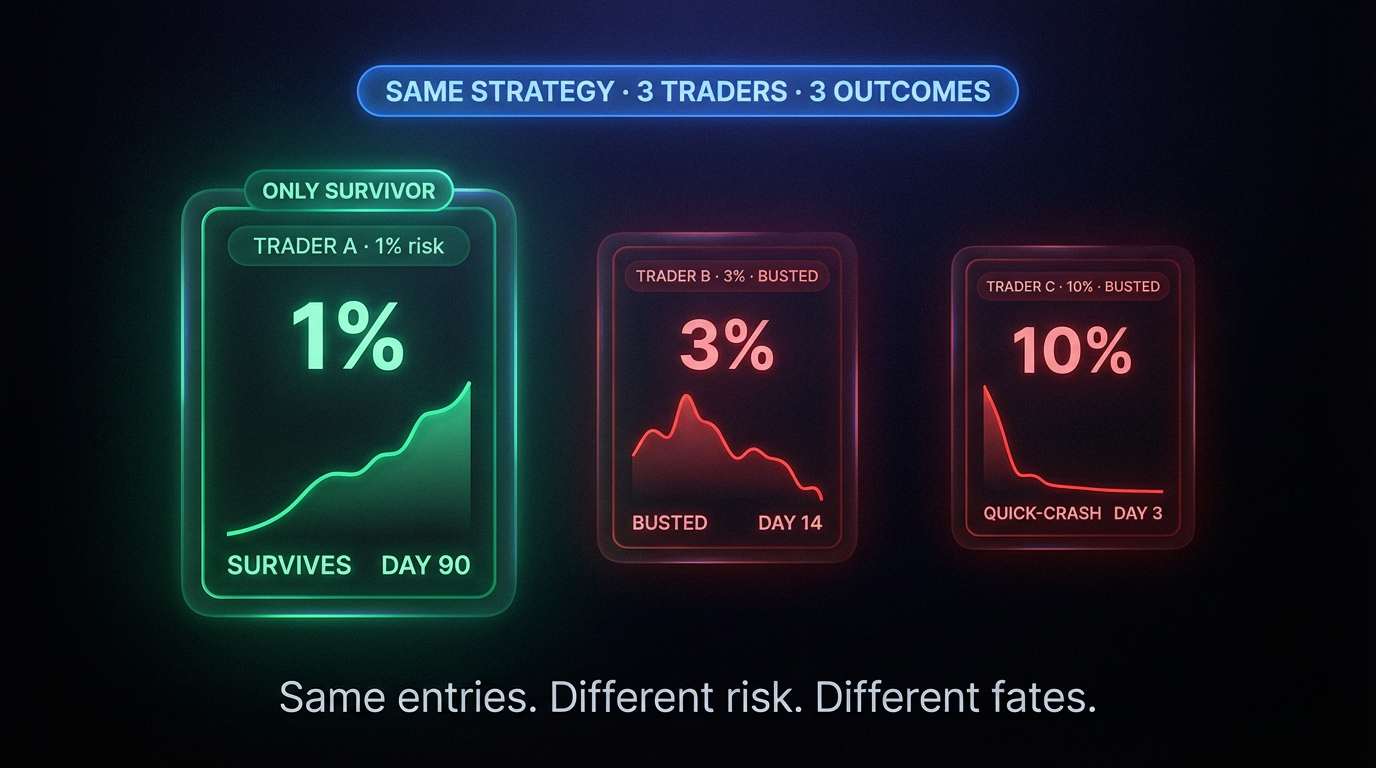
- Trade the challenge as if it were your real account, risk 1% per trade, respect the Daily Loss, don't try to hit the target in 2 days. Passing in 10 days with control is much more valuable than passing in 2 with luck.
- Document each trade, spreadsheet or TradingJournal. When you fail, you'll know what to correct. When you pass, you'll know what to repeat.
- On the first payout, withdraw EVERYTHING, the goal is not to "let the balance grow." It's to close the financial cycle: recover the challenge fee, the activation fee, and keep the net profit. From then on, it's pure margin.
Frequently asked questions
Is a Prop Firm a pyramid scheme?
No. In a pyramid scheme, new entrants pay those above them and there is no real product. In a Prop Firm, you pay for a specific service (trading skill evaluation), with clear rules, and payment to the passing trader comes from the aggregated profit of the business, not directly from new entrants. It's a model similar to insurance or a paid professional exam.
Is Prop Firm regulated in Brazil?
No. Prop Firms are foreign companies that sell an evaluation service. You are not contracting a financial product regulated by the CVM, you are contracting a paid evaluation. The payment you receive is taxable income as a service or capital gain, depending on the structure chosen by the accountant.
Which is the cheapest Prop Firm to start with?
In Futures: Apex 25K with coupon MARKET costs US$ 19.90 (90% discount). In Forex: FundingPips 5K costs US$ 29 in seasonal promotions.
Which Prop Firm has the highest Profit Split?
Apex Trader Funding pays 100%, the trader keeps all the profit, no split with the firm. The only charge is a one-time activation fee of US$ 85.
Does a Prop Firm really pay?
Established firms pay. Apex publishes monthly totals exceeding US$ 1 million since January 2023. FTMO has paid over US$ 600 million in 10 years of operation. The risk of non-payment is concentrated in new firms, without a track record and without presence on Trustpilot or public communities.
Can I combine different Prop Firms at the same time?
Yes. It's a standard practice among experienced traders, many maintain 3 to 5 simultaneous firms to diversify the risk of a specific firm's failure and multiply payout potential. Apex alone allows up to 20 accounts. Note: each firm requires a strategy compatible with its rules, and managing multiple accounts requires extra discipline.
What happens if I violate a rule?
It depends on the rule and the firm. Violating the Daily Loss or Max Drawdown usually closes the account immediately, you need to buy a reset (US$ 80–US$ 150) or a new challenge. Violating the Consistency Rule usually freezes the payout, but does not close the account: you need to continue trading until the aggregated profit brings the largest day to less than 30% or 50% of the total.
What should I read next?
If you are convinced by the model and are going to choose your firm, read our guide How to Pass the Challenge before paying. It covers the most common failures (oversizing, news trading, misunderstood Consistency Rule) and how to avoid each one.
Conclusion: is it worth it in 2026?
Prop Firms have consolidated as the most capital-efficient path for traders who already know what they are doing and don't have money to trade real capital in volume. The model has sufficient maturity in 2026, the firms that remained after the 2022–2023 closure cycle are solid operations, with verifiable monthly payouts and professional infrastructure.
The most common mistake is not "choosing the wrong firm." It's skipping the step of testing a system before the challenge. A Prop Firm doesn't teach you how to trade, it tests you. Those who arrive ready pass. Those who arrive improvising pay multiple resets until they realize the problem is technical.
If you don't have a system yet, the priority is not choosing a firm. It's building the foundation. Then come back here, read How to Pass the Challenge, choose a coupon on marketscoupons.com, and start with the smallest size. Three outcomes are possible: you pass and start cycling payouts; you fail and learn what needs adjustment; or you discover that Prop Firm is not your path. Any of the three costs less than US$ 200 in 30 days, and each is information no course sells.
Related guides
- How to Pass a Prop Firm Challenge, The 7 most common failures and how to avoid them
- Drawdown Management, Trailing, Static, EOD, and how each one trips you up
- Position Sizing in Prop Firms, Mathematical formula for sizing each trade
- How to Withdraw Your Profits, Payout, taxation, and the path to the first withdrawal
Disclaimer: This guide is educational content. Markets Coupons does not provide financial advice, does not issue investment recommendations, and does not guarantee results in Prop Firms. Trading involves risk. Consult a professional before any financial decision.