TradeDay Review 2026: Chicago Futures Prop Firm, 3 Drawdown Types, Day 1 Payouts
TradeDay right now, verified data (September 2026)
This box is generated from our price database and updates when the firm changes anything, so the numbers below never go stale even if the review above was written earlier.
Exclusive coupon: MARKETS 55% OFF
| Plan | Account | Full price | With coupon |
|---|---|---|---|
| Intraday /mo | 25K | $100 | $45 |
| Intraday /mo | 50K | $131 | $59 |
| Intraday /mo | 100K | $240 | $108 |
| Intraday /mo | 150K | $360 | $162 |
| End of Day /mo | 25K | $120 | $54 |
| End of Day /mo | 50K | $175 | $79 |
| End of Day /mo | 100K | $285 | $129 |
| End of Day /mo | 150K | $400 | $180 |
Activation fee: None · Consistency rule: Not required · Profit split: 80-95% · Trustpilot: 4.6 (1,418 reviews)
Last updated: April 21, 2026 · 12 min read · By Markets Coupons Team
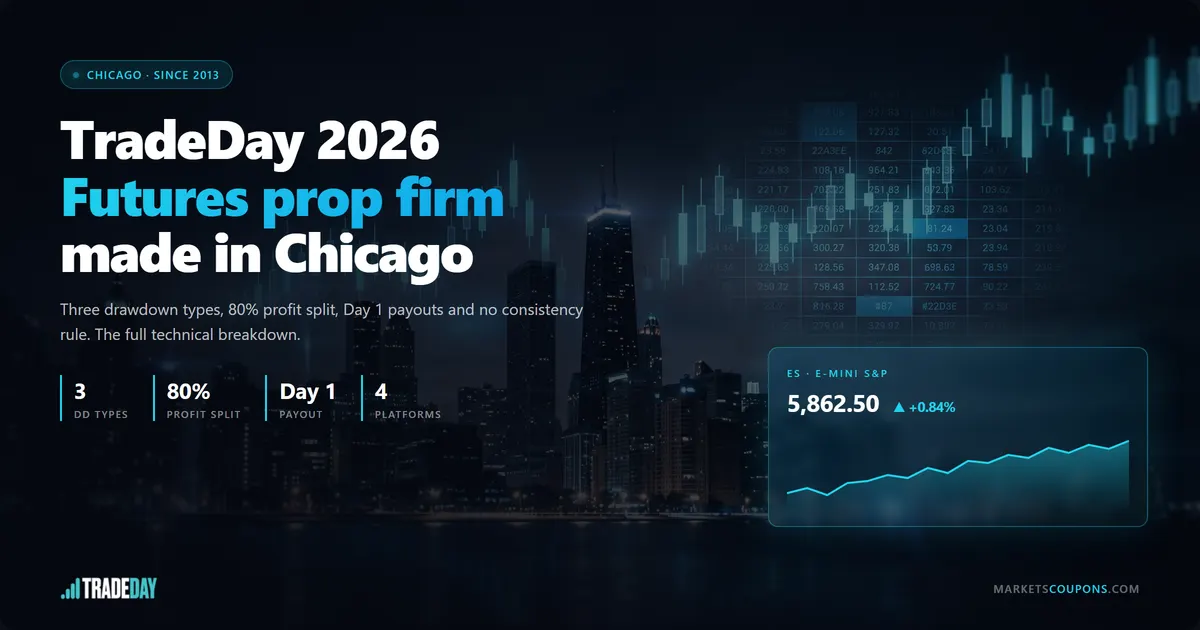
TradeDay is a Chicago-based futures prop firm operating out of 412 S.Wells, Chicago, Illinois, minutes from the CME trading floor. While the futures prop space in 2026 is crowded with firms that treat drawdown as a one-size-fits-all rule, TradeDay built its entire product around letting the trader choose the drawdown structure that fits their style: three distinct options (Intraday Trailing, End-of-Day Trailing, and Static), priced independently, with position limits and profit targets adjusted to match.
The firm covers the CME, CBOT, NYMEX, and COMEX futures markets via NinjaTrader, Tradovate, TradingView, and Jigsaw Trading, four of the most respected platforms in the futures retail space. Account sizes are $50K, $100K, and $150K. Profit split starts at 80% from day one and scales up to 95%. There is no consistency rule required to request a payout, and you can request your first payout on Day 1 of the funded account.
Trustpilot rating sits at 4.6 across 1,350 reviews, and the publicly stated evaluation approval rate is ~28.2%, low enough to signal that TradeDay isn't giving accounts away, high enough that disciplined traders with a repeatable edge genuinely pass.
This guide covers every drawdown type, pricing at every account size, the rules that matter, and how TradeDay stacks against Apex, Take Profit Trader, Bulenox, and Earn2Trade.
Quick Summary
Type: Futures prop firm (Chicago, USA, based in Chicago futures ecosystem)
Best for: Futures traders who want to pick their own drawdown structure
Programs: Intraday Trailing, EOD Trailing, Static (3 drawdown types × 3 sizes)
Profit split: 80% from day 1, up to 95%
Max account size: $150,000
Drawdown: $2K / $3K / $4K (Trailing) or $500 / $750 / $1K (Static)
Profit target: $3K / $6K / $9K (Trailing) or $1.5K / $2.5K / $3.75K (Static)
Platforms: NinjaTrader, Tradovate, TradingView, Jigsaw
Markets: CME, CBOT, NYMEX, COMEX
Trustpilot: 4.6 / 1,350 reviews
Consistency rule: None required to request payout
First payout: Day 1 eligible
Active offer: MARKETS (50% off + no activation fee)
Table of Contents
- What is TradeDay?
- The Three Drawdown Types: Intraday vs EOD vs Static
- Pricing (All Drawdown Types, All Sizes)
- Position Limits and Contract Caps
- Profit Targets and How to Hit Them
- Funded Stage: 80% Split, Day 1 Payouts, No Consistency
- Platforms: NinjaTrader, Tradovate, TradingView, Jigsaw
- TradeDay CoPilot (Education Add-On)
- TradeDay vs Apex vs TPT vs Bulenox vs E2T
- Pros and Cons
- How to Pass the TradeDay Evaluation
- Rules, Resets, and Prohibited Behavior
- A Note on the Simulated-Capital Model
- FAQ
What is TradeDay?
TradeDay is a futures-only prop evaluation firm operated by TradeDay LLC from Chicago, Illinois. Unlike forex-first firms that bolted futures onto a forex product, TradeDay is built for the futures trader: its entire platform stack, drawdown options, and position-limit structure reflect the realities of trading the CME complex (ES, NQ, YM, RTY), crude (CL), gold (GC), and the rest of the 25+ highly liquid US futures contracts.
The firm positions itself around three specific promises:
- Day 1 Payouts, once funded, you don't wait 30/60/90 days to withdraw profit.
- No consistency when funded, no rule forcing you to keep your best day under 30%/40%/50% of total profit at the payout stage.
- Keep up to 95%, starting at 80% profit split and climbing with performance.
These three differentiators respond to the most common complaints about Apex and several other large futures firms, where the "best day less than 50% of total" consistency rule routinely blocks traders from withdrawing profits they legitimately earned. If you're the kind of trader whose edge produces uneven PnL distributions, one or two strong sessions per month carrying a lot of the performance, TradeDay's no-consistency structure is a structural fit.
Key numbers:
- Based in Chicago, IL (412 S.Wells, 60607), physically close to CME's historical home
- 4.6 Trustpilot across 1,350 reviews
- ~28.2% evaluation approval rate publicly stated
- Four platforms: NinjaTrader, Tradovate, TradingView, Jigsaw
- Three drawdown types: Intraday Trailing, EOD Trailing, Static
- Three account sizes: $50K, $100K, $150K
- 80–95% profit split, Day 1 payout eligibility, no consistency rule
The Three Drawdown Types: Intraday vs EOD vs Static
This is the core decision in any TradeDay purchase. Pick wrong and you'll fight the rules instead of trading the market. Here's how each one actually works.
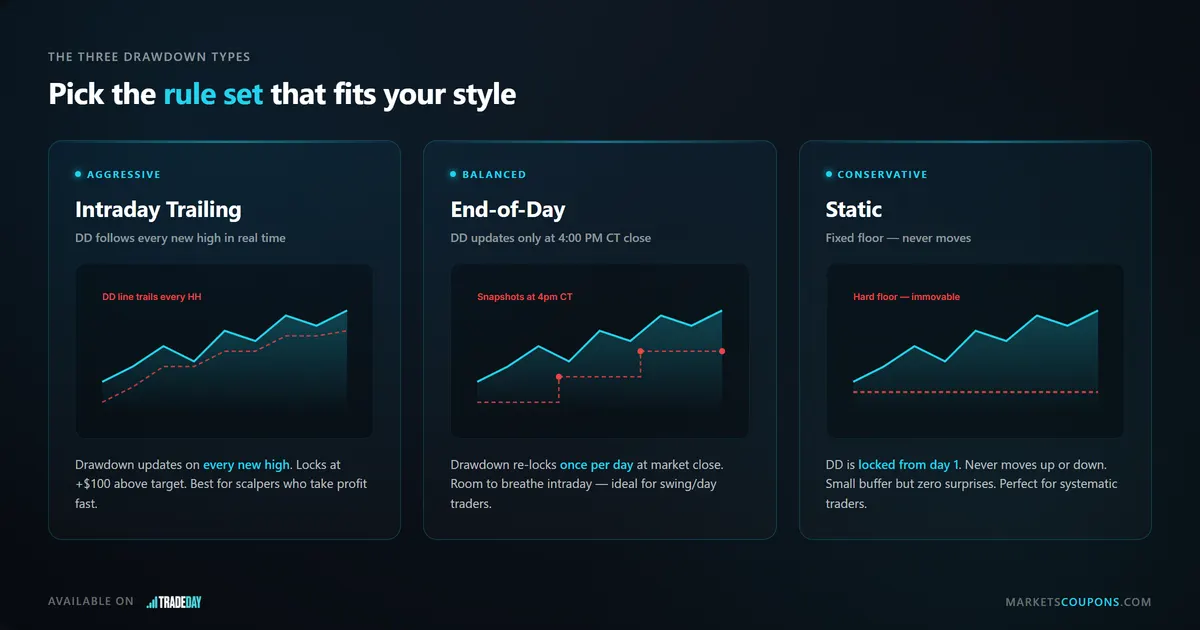
1. Intraday Trailing Maximum Drawdown (Intraday TMD)
The Intraday TMD calculates your drawdown limit from unrealized profits in real time during a trading session. Your drawdown ceiling moves up every time your unrealized equity hits a new high, even if you haven't closed the trade yet.
- Mechanic: Peak unrealized equity during the session sets the reference point. The drawdown limit is this peak minus the stated buffer ($2K/$3K/$4K).
- Freezes at starting balance: Once your account reaches the starting balance + max drawdown, the trailing stops moving and becomes fixed at that level (equivalent to a static DD from that point forward).
- Best for: Aggressive scalpers and intraday traders who close positions by end of session. You trade at your natural size and the drawdown naturally pulls up with your wins.
- Worst for: Traders who hold winners and watch them give back. An unrealized $1,800 peak that you let fade to breakeven is $1,800 eaten from your buffer.
2. End-of-Day Trailing Maximum Drawdown (EOD TMD)
The EOD TMD calculates drawdown from realized end-of-day equity at the 16:00 CT futures market close. During the session the drawdown ceiling stays fixed based on yesterday's closing balance, it only moves up after you close out with a new daily high.
- Mechanic: Daily close is the only "stamp" that updates the trailing reference. Intraday unrealized swings don't pull the stop toward you.
- Freezes at starting balance: Same freeze behavior, once you cross starting balance + max drawdown in realized closed profit, it locks.
- Best for: Swing-intraday hybrid traders who accept that winners sometimes breathe. Traders who'd rather have the session's full risk buffer available every morning.
- Worst for: No real "worst", EOD TMD is the more forgiving structure at the cost of slightly higher pricing vs Intraday.
3. Static Drawdown (SDL)
The Static Drawdown is a fixed maximum drawdown limit that does not move or track account balance growth. Your hard floor is set once at account creation and never changes.
- Mechanic: Starting balance minus fixed buffer ($500 on $50K, $750 on $100K, $1K on $150K). That number is your floor forever.
- Best for: Highly controlled traders who can comfortably operate inside a tiny, unmoving buffer. The profit target is also much smaller ($1.5K, $2.5K, $3.75K), so the risk:reward math is tight on both sides.
- Worst for: Traders who need room to breathe. Static's entire design is "one or two bad trades and you're out", the firm offsets this with lower profit targets, but the precision required is real.
Quick pick
- Intraday scalper, disciplined closer: Intraday TMD (cheapest)
- Swing-style hold, less stress: EOD TMD (middle-priced, most forgiving psychology)
- Tight, precise, fast-path to funded: Static (smallest targets, smallest buffer)
Pricing (All Drawdown Types, All Sizes)
All prices below shown with the MARKETS 50% off code vs the rack rate. MARKETS also includes no activation fee, TradeDay doesn't charge a separate one-time activation on top of the monthly evaluation fee once you pass.
Intraday Trailing
| Account Size | Profit Target | Trailing DD | Contracts | Price (MARKETS) | Rack Rate | Reset |
|---|---|---|---|---|---|---|
| $50K | $3,000 | $2,000 | 5 (50 micros) | $62/mo | $125 | $60 |
| $100K | $6,000 | $3,000 | 10 (50 micros) | $115/mo | $230 | $110 |
| $150K | $9,000 | $4,500 | 15 (50 micros) | $175/mo | $350 | $165 |
End-of-Day Trailing
| Account Size | Profit Target | Trailing DD | Contracts | Price (MARKETS) | Rack Rate | Reset |
|---|---|---|---|---|---|---|
| $50K | $3,000 | $2,000 | 5 (50 micros) | $87/mo | $175 | $85 |
| $100K | $6,000 | $3,000 | 10 (50 micros) | $142/mo | $285 | $135 |
| $150K | $9,000 | $4,500 | 15 (50 micros) | $197/mo | $395 | $195 |
Note: TradeDay discontinued the Static drawdown option, only Intraday and End-of-Day remain available for new evaluations.
Evaluation pricing is monthly, you pay each month until you pass or stop. Once funded, there is no ongoing monthly fee on the funded account itself (only new evaluations or resets carry fees).
Position Limits and Contract Caps
One detail newer futures traders miss: contract limits are hard caps. Exceed them even briefly and the account is at risk. TradeDay's limits are:
Intraday and EOD (same limits)
- $50K: 5 full contracts OR 50 micros
- $100K: 10 full contracts OR 50 micros
- $150K: 15 full contracts OR 50 micros
Static (much tighter)
- $50K: 1 full contract OR 10 micros
- $100K: 2 full contracts OR 20 micros
- $150K: 3 full contracts OR 30 micros
The Static size limits reflect the math of the tiny static drawdown, $500 on $50K can be consumed by two full ES contracts ticking 2.5 points against you. You're forced to trade small, which is part of why the profit target is also small.
Practical note: Most disciplined traders don't run full limits. On the $50K Intraday, scaling up to 3-4 contracts during your best setups is plenty, and leaves room for a second position if needed.
Profit Targets and How to Hit Them
Targets are absolute dollar amounts, not percentages. Hit them and you move to funded. The math varies by structure:
Intraday / EOD Targets
- $50K → $3,000 target = 6% of account
- $100K → $6,000 target = 6% of account
- $150K → $9,000 target = 6% of account
A consistent 6% target is on the lower end of industry norms (Apex is 8%, FTMO is 10%). The tradeoff is the trailing drawdown: you have less buffer than Apex's 5% static but your target is easier to hit.
Static Targets
- $50K → $1,500 target = 3% of account, with only $500 DD buffer (3:1 ratio target:DD)
- $100K → $2,500 target = 2.5% of account, with $750 DD buffer
- $150K → $3,750 target = 2.5% of account, with $1,000 DD buffer
Static's math is aggressive in both directions, small target, tiny buffer. If you can take 30-50 ticks of ES per week with surgical precision, Static is the fastest path to funded at TradeDay.
Funded Stage: 80% Split, Day 1 Payouts, No Consistency
Once you hit target without breaching drawdown, TradeDay moves you to a funded account. The terms are where this firm stands out from the Apex/Bulenox crowd:
80% profit split from day one
You keep 80% of profits starting from the first funded trade. This is a day-one figure, no scaling ladder required to unlock it. Higher tiers (up to 95%) are reachable based on sustained performance and account loyalty, but the baseline is already above the industry median for futures.
Day 1 Payouts
You can request your first payout on Day 1 of the funded account. Most firms in the space gate this behind:
- Minimum 5-10 trading days on the funded account, OR
- A consistency rule (best day ≤ 50% of total profit), OR
- A minimum profit threshold before the first withdrawal is approved.
TradeDay removes all three. If you have profit on Day 1 of the funded stage, you can withdraw it.
No Consistency Rule
This is the biggest structural win for traders whose edge concentrates returns in a few strong sessions per month. At Apex, if 55% of your monthly profit came from a single FOMC-day trade, your payout is blocked until you "balance" it with other profitable days. TradeDay doesn't enforce this at the payout stage.
Caveat: No-consistency doesn't mean no-rules. Standard prohibitions still apply (no latency arbitrage, no HFT exploits, no copy-trading across multiple TradeDay accounts). The rule that's missing is the "consistency at payout" gate, not the general rulebook.
Platforms: NinjaTrader, Tradovate, TradingView, Jigsaw
TradeDay supports four platforms, each suited to different styles:
NinjaTrader
Industry-standard for futures. Full DOM (depth of market), advanced charting, strategy automation via NinjaScript, order flow tools with Footprint. Free license typically included via TradeDay for funded accounts. Best for traders who use order flow, volume profile, or automated strategies.
Tradovate
Web and mobile-first, no desktop install required. Cleaner interface than NinjaTrader with native mobile trading. Best for traders who want to manage positions from phone or tablet without a second install. Lighter on advanced order-flow tooling compared to NinjaTrader.
TradingView
Best-in-class charting, community indicators, alerts, and scripting via Pine Script. Execute futures orders directly from TradingView charts. Best for chart-driven, technical-analysis-heavy traders who already live in TradingView for analysis.
Jigsaw Trading
Specialized order-flow platform. Reconstructed DOM, heatmap, trade tape analysis, and unique tools for scalpers. Best for tape-reading specialists and scalpers who want institutional-grade order-flow visualization.
All four are available across every account type and every drawdown structure. You're not locked into one platform for the duration of an evaluation, you can switch as long as you're using a TradeDay-approved broker routing.
TradeDay CoPilot (Education Add-On)
Separate from the evaluation product, TradeDay offers CoPilot at $24/month, an education and content subscription that is not a funded account or evaluation:
- Access to TradeDay's exclusive content library
- Daily webinars led by the TradeDay education team
- Trading courses for both beginners and advanced traders
- Live market squawk service (audio commentary during market hours)
- TradeDay's award-winning daily research reports
CoPilot is aimed at traders who want the educational content and daily research but aren't ready to buy an evaluation yet, or who want to continue accessing the daily squawk and research even between active evaluations.
TradeDay vs Apex vs TPT vs Bulenox vs E2T
TradeDay vs Apex
| Factor | TradeDay | Apex |
|---|---|---|
| Price ($100K Intraday) | $115/mo | $39.90 lifetime (MARKET) |
| Profit target | $6K (6%) | $8K (8%) |
| Drawdown options | 3 (Intraday/EOD/Static) | 2 (Intraday/EOD) |
| Consistency rule at payout | None | 30% rule |
| Profit split | 80-95% | 100% first $25K, then 90% |
| Max accounts | 5 | 20 |
| Day 1 payout | Yes | Yes |
| Trustpilot | 4.6 / 1,350 | 4.4 / 18.3K |
Verdict: Apex is cheaper per evaluation (lifetime pricing with MARKET vs monthly). TradeDay wins on drawdown flexibility (Static option) and the no-consistency rule at the payout stage, a huge factor for traders whose edge produces uneven PnL distributions.
TradeDay vs Take Profit Trader (TPT)
| Factor | TradeDay | TPT |
|---|---|---|
| Price ($100K) | $115/mo | ~$90 (40% off) |
| Drawdown | 3 options | EOD trailing |
| Profit split | 80-95% | 90% |
| Consistency rule | None | None |
| Platforms | 4 (NT, TV, TV, Jigsaw) | 15+ |
| Day 1 payout | Yes | Yes |
Verdict: TPT is cheaper and has broader platform support. TradeDay wins on Static drawdown availability, if you want a fixed-limit account, TPT doesn't offer that structure.
TradeDay vs Bulenox
| Factor | TradeDay | Bulenox |
|---|---|---|
| Price ($100K) | $115/mo | $17 lifetime (MARKET) |
| Drawdown | 3 options | Trailing |
| Profit split | 80-95% | 100% first $10K, then 90% |
| Min days | None | Pass in 1 day |
| Consistency | None | None |
| Trustpilot | 4.6 / 1,350 | 4.8 / 1.5K |
Verdict: Bulenox is dramatically cheaper and has higher Trustpilot. TradeDay wins on drawdown structure flexibility and platform variety (Jigsaw + TradingView native). Choose Bulenox for fastest-cheapest path; TradeDay for drawdown optionality.
TradeDay vs Earn2Trade
| Factor | TradeDay | Earn2Trade |
|---|---|---|
| Price ($100K Trader Career Path) | $115/mo | $115 (50% off via MARKETSCOUPONS) |
| Drawdown | 3 options | EOD fixed |
| Profit split | 80-95% | 80% |
| Min days | None | 10 |
| News trading | Allowed | NOT allowed |
| Free NinjaTrader license | Yes (funded) | Yes |
Verdict: Similar price point. TradeDay wins on no-minimum-days and news trading; E2T wins on free NinjaTrader/Journalytix included and the bigger scaling ceiling (up to $400K).
Pros and Cons
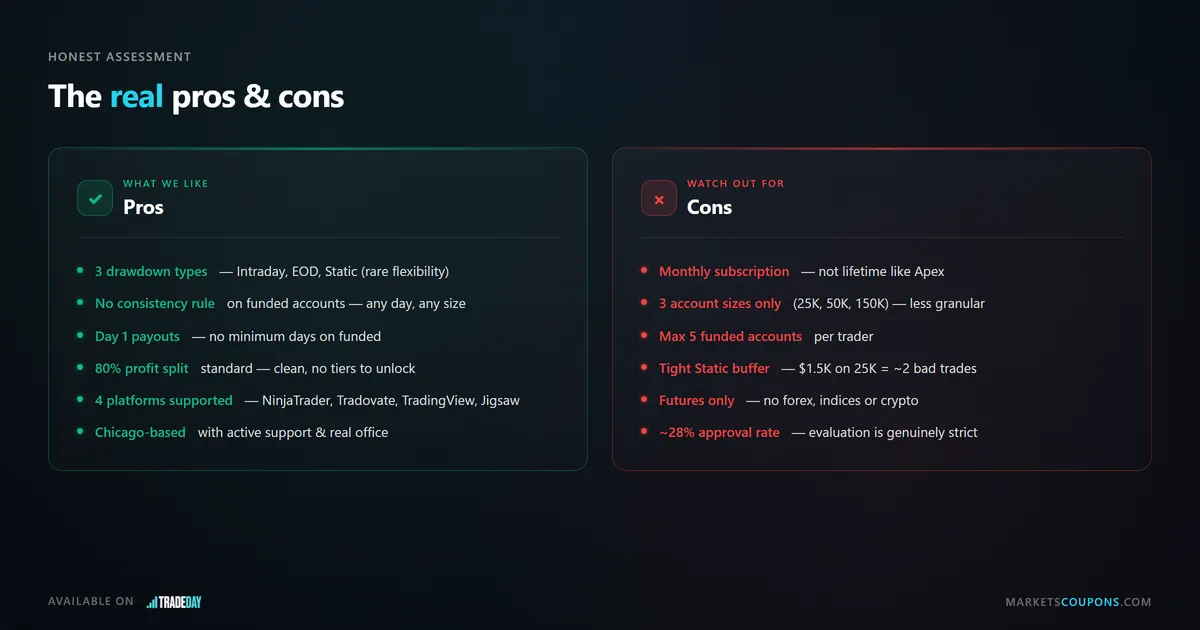
Pros
- Three distinct drawdown types, Intraday, EOD, Static, let you match the structure to your edge
- No consistency rule at payout, the single biggest structural advantage for traders with concentrated PnL distributions
- Day 1 Payouts, request your first withdrawal from day one of the funded account
- 80% split starting, up to 95%, above the futures industry median from day one
- Four premium platforms, NinjaTrader, Tradovate, TradingView, Jigsaw, all supported
- Chicago-based, physical presence in the US futures trading ecosystem, not an offshore shell
- 4.6 Trustpilot across 1,350 reviews, strong reputation on meaningful review volume
- No minimum trading days on the evaluation, pass as fast as your setups allow
- Static drawdown option, rare in the futures prop space, forces precision but removes trailing psychology
- MARKETS includes no activation fee, some firms layer a separate activation on top
Cons
- Monthly pricing model, more expensive than Apex's lifetime model for a single evaluation cycle
- Only three account sizes ($50K/$100K/$150K), no $25K entry-level or $250K+ scaling like Bulenox or Apex
- Max 5 accounts, lower than Apex's 20 or Bulenox's 20, limits multi-account diversification
- No sub-$100 monthly evaluation, even with MARKETS, Static $50K starts at $115/mo
- Static account ratios are tight, $500 DD on $50K means 2 bad ES ticks and you're under pressure
- Scaling ceiling not publicly published, most futures firms advertise a clear scaling ladder; TradeDay's ladder is less publicized
- ~28.2% approval rate, honest number, but means 7 out of 10 traders don't pass
How to Pass the TradeDay Evaluation
- Pick your drawdown type. Intraday for scalping/aggressive day traders. EOD for hybrid styles that want more breathing room. Static only if you have surgical risk control and can hit small targets fast.
- Pick your account size. Start with $50K or $100K. The $150K is 50% larger everything (target, DD, contracts) but also 50% more expensive, not a free upgrade.
- Apply MARKETS at checkout, 50% off plus no activation fee. Valid at the time of this guide's publication.
- Install your platform. NinjaTrader for order flow, Tradovate for mobile, TradingView for chart analysis, Jigsaw for tape reading. Configure risk settings before your first trade.
- Respect position limits. On $100K Intraday you can size up to 10 full contracts but that's not the point. Trade 2-4 contracts per setup until you're comfortable.
- Manage trailing drawdown actively. On Intraday, your peak unrealized equity sets the ceiling. Let a winner run too long and watch it reverse, you've just eaten part of your buffer. On EOD you can let winners breathe during the session.
- Plan around the 6% target. $6K on $100K = 60 points of ES or 120 ticks of NQ. Space this across 10-15 disciplined sessions instead of aiming for one home run.
- Journal every trade. You need to know your win rate, your average R, and your max consecutive losers before the $3K/$6K/$9K target is reachable.
- Use the reset option if needed. Resets are $80-$149 and let you start fresh without a new full evaluation purchase. Use them before breaching DD, reset with profit left is cheap recovery.
- Move to funded. 80% split from day one, request a Day 1 payout if you have profit, no consistency rule to satisfy.
Rules, Resets, and Prohibited Behavior
Standard industry rules apply:
- No latency arbitrage, exploiting feed lag between broker and exchange is prohibited
- No HFT / automated spam orders, order-per-second limits apply
- No copy trading across multiple TradeDay accounts, one account, one trader
- EAs permitted within standard restrictions
- News trading allowed, no restrictions around NFP, CPI, FOMC on any drawdown type
- Hedging within a single account permitted
- Resets available at $80-$149 depending on account size
- Breach of DD = account closed, purchase a new evaluation or reset to try again
A Note on the Simulated-Capital Model
TradeDay, like essentially every retail futures prop firm in 2026, operates on a simulated-capital evaluation model:
- Your funded account is a simulated environment mirroring live futures market data
- Fills use real market prices via the platform's data feed
- Payouts come from TradeDay's revenue, not from broker clearing of your positions
- Payouts are technically discretionary under the user agreement
Does TradeDay pay? Yes, the 4.6 Trustpilot on 1,350 reviews includes many specific payout confirmations, and the firm's public positioning around Day 1 Payouts is backed by funded-trader testimonials. The discretionary clause in the user agreement exists to protect TradeDay from fraud and rule violations, not as a default escape hatch from paying legitimate winners.
If you're comparing TradeDay to a regulated broker/dealer, this is not that. If you're comparing it to Apex, Bulenox, TPT, Earn2Trade, Leeloo, or any other futures prop in the same category, TradeDay is competitive and operates with the same structural model, just with better payout terms (no consistency rule, Day 1).
FAQ
Is TradeDay legit?
Yes. Chicago-based (412 S.Wells, IL 60607), 4.6 Trustpilot across 1,350 reviews. The firm publicly states ~28.2% evaluation approval rate, which signals they're not just printing accounts. Start with a $50K or $100K evaluation to validate before scaling.
What's the TradeDay coupon?
MARKETS, 50% off any evaluation PLUS no activation fee. Applies across Intraday, EOD, and Static drawdown at all three account sizes.
What are the three drawdown types?
Intraday Trailing (moves in real time with unrealized equity peak), EOD Trailing (moves only at 16:00 CT daily close), and Static (fixed floor, never moves).
What's the profit split?
80% from day one on the funded account, with the potential to reach 95% based on sustained performance.
Does TradeDay have a consistency rule?
No consistency rule is required to request a payout at the funded stage. This is one of TradeDay's biggest structural advantages vs Apex.
Can I get a Day 1 payout?
Yes. You can request your first withdrawal from day one of the funded account, without waiting for a minimum days/profit threshold.
What platforms does TradeDay support?
NinjaTrader, Tradovate, TradingView, and Jigsaw Trading. All four work across every account type.
Can I trade forex on TradeDay?
No. TradeDay is futures-only (CME, CBOT, NYMEX, COMEX). For forex use FTMO, FundedNext, FundingPips, or CTI.
Is news trading allowed?
Yes. TradeDay does not restrict trading around major news events (NFP, CPI, FOMC). Trade the release if that's your edge.
What happens if I fail the evaluation?
The account closes. You can purchase a new evaluation or use the reset option ($80-$149) to restart the current account without a full repurchase.
Is the TradeDay CoPilot the same as a funded account?
No. CoPilot ($24/mo) is an education and content subscription, webinars, courses, squawk, daily research. It is not a funded trading account and does not replace the evaluation path.
Related Guides on Markets Coupons
- Apex Trader Funding Review, largest US futures firm, 90% off lifetime with MARKET
- Bulenox Review, pass in 1 day, 89% off lifetime with MARKET
- Take Profit Trader Review, 90% split, Day 1 payouts, 40% off with MARKET40
- Earn2Trade Review, Trader Career Path, free NinjaTrader, 50% off with MARKETSCOUPONS